Quick answer
What is a good housekeeping process for small hotels?
A good housekeeping process for small hotels has five parts: one shared room status board, a fixed cleaning order for each room type, a short inspection before the room is released, a daily linen and supplies count, and a quick handover between front desk and housekeeping. Track rooms ready on time and cleanliness complaints every week.
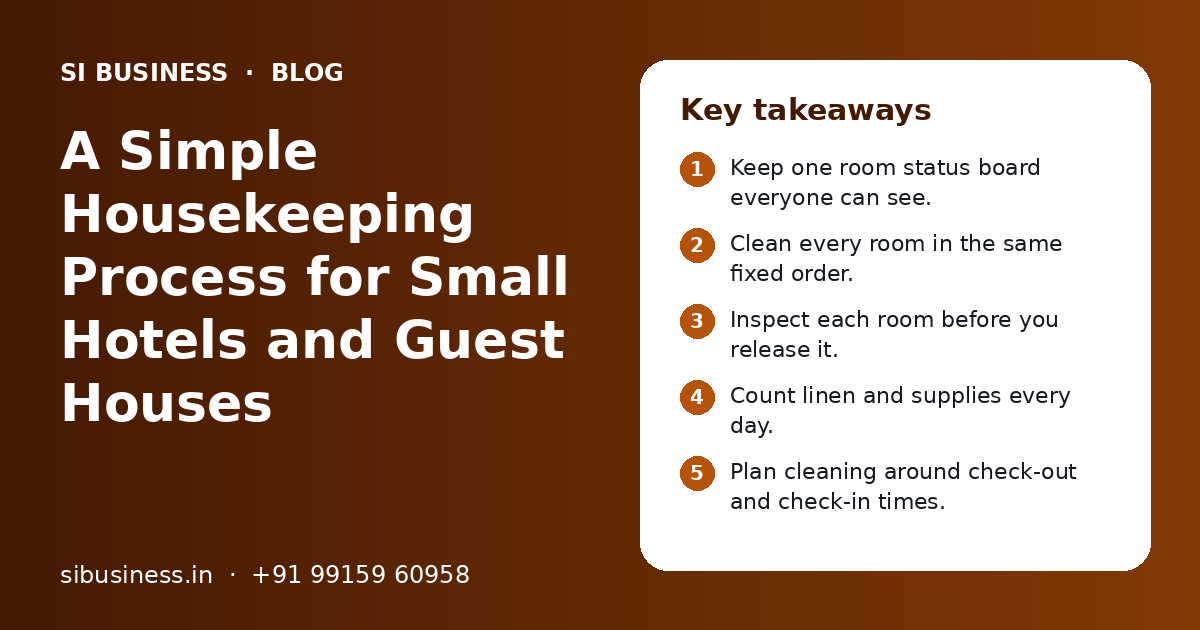
Key takeaways
- Keep one room status board everyone can see.
- Clean every room in the same fixed order.
- Inspect each room before you release it.
- Count linen and supplies every day.
- Plan cleaning around check-out and check-in times.
- Track rooms ready on time every week.
Why does a small hotel need a housekeeping process?
A small hotel needs a housekeeping process because rooms must be ready on time and clean to the same standard, every day, no matter who is on duty. Without a process, quality depends on one or two good staff members and on the owner checking everything.
Most small hotels, guest houses and homestays start with a trusted helper and an owner who checks every room. This works until the hotel grows or the season gets busy.
A written housekeeping process for small hotels answers simple questions. Which room is cleaned first? Who checks it? How does the front desk know it is ready? What happens when a tap leaks or a towel is missing? When these answers are clear, staff stop guessing and guests stop waiting.
What are the main steps in a hotel housekeeping process?
The main steps are: plan the day from the occupancy list, clean rooms in priority order, follow a fixed cleaning sequence inside each room, inspect, update room status and restock. The same cycle repeats every day.
- 1
Start the day with the occupancy list
Each morning, the front desk shares a list of expected check-outs, stayovers, arrivals and early check-in requests. Housekeeping plans the day from this list, not from memory.
- 2
Set the cleaning priority
Clean rooms needed for early arrivals first, then other check-out rooms, then stayover rooms when guests are out. Leave vacant clean rooms for a quick check.
- 3
Assign rooms to each staff member
Give each person a clear list of rooms. Balance check-out rooms and stayover rooms, because a check-out clean takes much longer.
- 4
Clean in a fixed sequence
Inside the room, follow the same order every time: air the room, strip linen, clear trash, clean the bathroom, dust top to bottom, make the bed, restock, then mop or vacuum last.
- 5
Inspect before release
A supervisor, the manager or a trained senior staff member checks the room against a short checklist before it is marked ready.
- 6
Update room status at once
As soon as a room passes inspection, update the status board so the front desk can assign it.
- 7
Close the day
Count linen and supplies, note pending repairs, record lost and found items and share a short end-of-day report.
If you want to write these steps down properly for your team, our SOP documentation services turn steps like these into short guides with photos.
How should the front desk and housekeeping share room status?
The front desk and housekeeping should share one room status board that both teams update in real time. It can be a whiteboard, a shared sheet, a simple app or a hotel software screen, as long as there is only one version.
Most delays at check-in come from poor communication, not slow cleaning. A room is clean, but no one told the desk. Or the desk gives a room that is still being cleaned. Clear status codes fix this.
| Status | What it means | Who changes it |
|---|---|---|
| Occupied | A guest is staying in the room | Front desk at check-in |
| Vacant dirty | Guest has checked out, room not yet cleaned | Front desk at check-out |
| Cleaning in progress | Staff are working in the room | Housekeeping staff |
| Vacant clean | Cleaned but not yet inspected | Housekeeping staff |
| Inspected and ready | Checked and ready to sell | Supervisor or manager |
| Out of order | Cannot be sold until a repair is done | Manager or maintenance |
Using WhatsApp for room updates
Many small hotels use a WhatsApp group between the desk and housekeeping. This is fine if you set rules. Use a fixed format, such as room number plus status. Do not mix guest requests, staff chat and room status in one group. Our page on WhatsApp business operations explains how to set up groups, formats and labels so messages do not get lost.
What should a room cleaning checklist include?
A room cleaning checklist should cover the bathroom, bed and linen, surfaces and dust, floor, supplies, electrical items and a final look from the guest's eye. Keep it to one page and in the language your staff read best.
Check-out room cleaning checklist
- Open windows or curtains and switch on the exhaust fan
- Remove used linen, towels and all trash
- Check for guest items left behind and log them
- Clean toilet, wash basin, shower area, mirror and taps
- Check hot water, flush and drainage
- Dust headboard, side tables, shelves, wardrobe and TV
- Make the bed with fresh linen and check for stains or hair
- Restock towels, toiletries, water bottles, tea and coffee items
- Check lights, AC, TV, kettle and charging points
- Sweep, mop or vacuum the floor, including under the bed
- Stand at the door and look at the room as a guest would
A stayover room needs a lighter clean: make the bed, clear trash, clean the bathroom and restock. Respect the do not disturb sign.
Print the checklist in Hindi, Punjabi or your staff's local language, with small photos of a finished bed and bathroom. If staff still skip steps, read our post on why staff do not follow SOPs.
Need help with your project?
Talk to the SI Business team. Free first call, simple advice, clear quote.
How do you inspect rooms before guests check in?
Inspect each room with a short list of the points guests notice most, such as the bathroom, bed, smell, floor and working items. In a small hotel, the manager or one senior staff member can check every room in a few minutes.
Inspection is the step most small hotels skip when busy, yet a quick check catches a missing towel or a broken bulb before the guest sees it.
| Area | What to check | Common miss |
|---|---|---|
| Bathroom | Toilet, floor, drain, mirror, towels, toiletries | Hair in the drain or on the floor |
| Bed | Clean sheets, pillow covers, no stains, neat corners | Old pillow cover left on |
| Smell | Fresh air, no damp or smoke smell | Damp smell in rooms with no window |
| Surfaces | No dust on tables, shelves, headboard | Dust on top of the TV or wardrobe |
| Working items | Lights, AC, TV, kettle, hot water, Wi-Fi card | Remote with weak batteries |
| Supplies | Water, tea and coffee, slippers if offered | Water bottles not replaced |
Record failed points. If the same item fails again and again, fix the process or the supplies behind it, not only the staff member.
How should a small hotel manage linen and room supplies?
Manage linen and supplies with a fixed stock level for each item, a daily count of what goes to the laundry and what comes back, and a simple reorder list. This stops last-minute shortages on busy days.
Linen is a hidden cost in many small hotels. Sheets go missing at the laundry and no one knows how many sets are left until a full house arrives. Most small hotels use an outside laundry, so counting what goes out and comes back matters even more.
A simple linen routine
- Set a par level for each linen item per room, based on how quickly your laundry returns it.
- Count soiled linen before it goes to the laundry, and write the count on a slip.
- Count clean linen when it comes back and match it with the slip.
- Keep stained or torn items aside and record them before replacing.
- Do a full linen count once a month and compare with your par levels.
Treat toiletries, water bottles, cleaning chemicals and trash bags the same way. Set a minimum level, check it weekly and reorder before you run out. Our guide to the inventory management process explains how to set reorder levels and avoid stock mismatch. If you use an outside laundry, clear terms and a weekly check of counts are part of a good vendor management process.
How do you plan housekeeping staff for busy days?
Plan housekeeping staff from the expected check-outs and arrivals for each day, not from a fixed roster. Busy weekends, holidays, wedding seasons and tourist seasons need extra hands at the right hours, mostly between check-out and check-in.
The pressure comes in a short window between late-morning check-outs and afternoon check-ins.
- Look at the next week's bookings every few days and mark the heavy days
- Keep more staff on duty during the check-out to check-in window
- Keep a short list of trained part-time helpers for peak season
- Do deep cleaning tasks on quiet days, not on full days
For more on building a fair roster, see our post on how to plan staff shifts in a small business.
Which housekeeping numbers should a hotel owner track?
Track a few numbers every week: rooms ready by check-in time, rooms failed at inspection, cleanliness complaints, linen loss and pending repairs. These five show whether your housekeeping process is working.
| Number | How to measure it | What it tells you |
|---|---|---|
| Rooms ready on time | Rooms ready by check-in time divided by rooms needed | Whether planning and speed are right |
| Inspection fails | Rooms that failed inspection each week | Whether the cleaning checklist is followed |
| Cleanliness complaints | Complaints and review comments about cleaning | What guests actually notice |
| Linen loss | Items missing or damaged in the monthly count | Leaks at the laundry or in the store |
| Pending repairs | Open repair requests and their age | Whether maintenance keeps pace |
Read guest reviews on booking sites every week and tag each comment about cleaning, smell or bathrooms. A customer feedback system makes this easier, because comments from reviews, WhatsApp and check-out are kept in one place. Put the five numbers on one sheet or a simple KPI dashboard for owners so you can see the trend at a glance.
What mistakes should small hotels avoid in housekeeping?
The most common mistakes are skipping inspection, keeping room status in people's heads, running out of linen, ignoring small repairs and training staff only by word of mouth. Each one is easy to fix once you see it.
- No inspection step, so the guest becomes the inspector
- Room status shared only by shouting or phone calls
- No count of linen sent to and returned from the laundry
- Small repairs noted but not assigned to anyone
- The owner fixes problems personally instead of fixing the process
If you run more than one property, these gaps multiply. Our page on multi-branch operations management shows how to keep one standard across sites. To find where your hotel loses time today, start with an operations audit, or see how we approach hotels and other service businesses on our operations improvement by industry page.
SI Business is powered by Shivah Web Tech, with 11+ years of experience and a 25+ member in-house team in Mohali, Punjab. We help owners map their process, write simple SOPs and set up the numbers that matter. Book a free call and you get a clear quote after we understand your property.
Frequently Asked Questions
How long should it take to clean a hotel room after check-out?
It depends on the room size, the bathroom, how the guest used the room and how trained your staff are. A check-out room takes much longer than a stayover room. The best way to know is to time a few rooms on normal days, then plan staff from those real times instead of a guess.
What is the difference between a check-out clean and a stayover clean?
A check-out clean prepares the room for a new guest. All linen is changed, the bathroom is fully cleaned, the room is dusted and restocked and then inspected. A stayover clean is lighter. Staff tidy the room, clean the bathroom, clear trash and restock while respecting the guest's things and privacy.
Who should inspect rooms in a small guest house?
In a small guest house, the owner, the manager or one trained senior staff member can inspect rooms. What matters is that someone other than the person who cleaned the room checks it against a short list before the front desk gives it to a guest. Rotate the job if one person cannot cover every shift.
Do I need hotel software for housekeeping?
Not at first. A small hotel can run a good housekeeping process with a whiteboard, printed checklists and a shared sheet. Software helps when you have more rooms, more staff or more than one property, because room status, repair requests and reports stay in one place and update on every phone.
How can I reduce complaints about cleanliness in online reviews?
Find the exact things guests mention, such as hair in the bathroom, damp smell or stained sheets. Add those points to your inspection list, fix the supply or process gap behind them and check the same points every day. Reply politely to each review and track the number of cleaning complaints every week.
How many sets of linen should a small hotel keep per bed?
There is no single number. It depends on how fast your laundry returns linen, how busy you are and how often items wear out. Count one set on the bed, one at the laundry and one in the store as a starting point, then adjust after watching shortages and laundry delays for a few weeks.