Quick answer
What is a good cake order process for small bakeries?
A good cake order process for small bakeries has six steps: take every order on one fixed order form, confirm details in writing with the customer, collect an advance, put the order on a production board, check the cake against the form before handover, and record pickup or delivery. Track late and wrong orders every week.
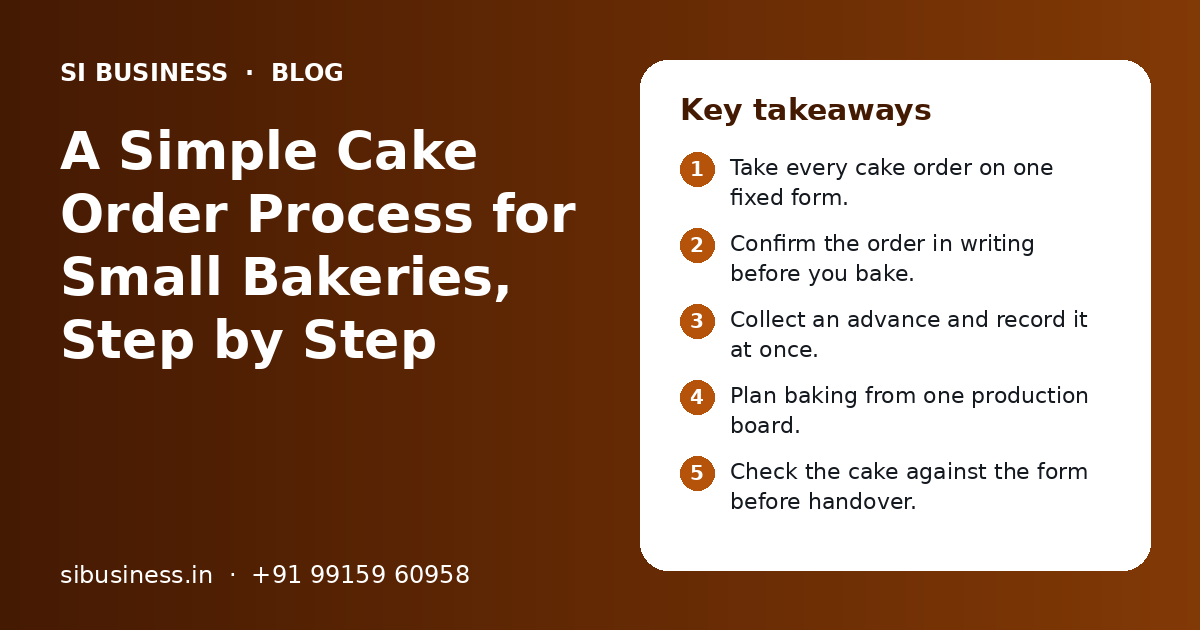
Key takeaways
- Take every cake order on one fixed form.
- Confirm the order in writing before you bake.
- Collect an advance and record it at once.
- Plan baking from one production board.
- Check the cake against the form before handover.
- Track late and wrong orders every week.
Why does a small bakery need a cake order process?
A small bakery needs a cake order process because custom orders have many details, fixed deadlines and no second chance. A clear process makes sure every order is taken, baked and handed over the same way, no matter who is on the counter.
Orders come at the counter, on the phone and on WhatsApp, often to the owner's personal number. Details sit on paper slips or only in the chat. When the shop is busy, a slip gets lost or a message is missed.
A written cake order process for small bakeries fixes this, and lets the owner hand work to staff. For a wider view, see our guide to the order management process.
What are the steps in a cake order process?
The main steps are: take the order on a fixed form, confirm it in writing, collect an advance, add it to the production board, bake and decorate, check it against the form, and hand it over with final payment. Each step has one owner.
- 1
Take the order on one fixed form
Every order, from the counter, phone or WhatsApp, goes on the same order form. No order is taken only by memory or only in a chat.
- 2
Give each order a number
Use a simple running number, such as the date plus a serial. The customer, the kitchen and the counter all use this number.
- 3
Confirm the details in writing
Send the customer a short summary on WhatsApp or SMS: flavour, weight, message, design, date, time and amount. Ask them to reply to confirm.
- 4
Collect the advance
Take the agreed advance by UPI, card or cash and note it on the form. An order without an advance stays on hold.
- 5
Add the order to the production board
Put the order on a board or sheet sorted by ready-by time. The kitchen works only from this board.
- 6
Bake, decorate and pack
The kitchen prepares the cake as per the form, including the photo of the design if the customer shared one.
- 7
Check before handover
A second person checks the cake against the form: flavour, weight, message spelling, design and candles or toppers.
- 8
Hand over and close the order
Collect the balance, give the bill, mark the order as delivered and note any feedback or issue.
Keep these steps on one printed sheet at the counter and in the kitchen. Our SOP documentation service turns steps like these into short guides with photos.
What details should a cake order form capture?
A cake order form should capture customer details, cake details, design, message, date and time, pickup or delivery, and payment. If a detail can go wrong, it needs its own box on the form.
| Section of the form | What to write | Why it matters |
|---|---|---|
| Order basics | Order number, date taken, staff name, order source | You know who took it and where it came from |
| Customer | Name, mobile number, alternate number | You can reach the customer if anything changes |
| Cake | Flavour, weight, shape, number of tiers, egg or eggless | These are the most common points of confusion |
| Design | Colour, theme, reference photo, toppers, candles | The kitchen sees exactly what the customer expects |
| Message | Exact text, written in capital letters, language | Stops spelling mistakes on names |
| Timing | Ready-by date and time, event time | Sets the order on the production board |
| Handover | Pickup or delivery, address, landmark, receiver name | Avoids wrong address and missed deliveries |
| Payment | Total amount, advance paid, mode, balance due | Stops disputes at handover |
Write egg or eggless in its own box, ask about allergies such as nuts, and save the design photo under the order number. The tool can be a printed book, a Google Form or software. The rule is the same: one form, all boxes filled, every time.
How should a bakery take advance payment and confirm orders?
A bakery should take an advance on every custom cake order and send a written confirmation before the order goes to the kitchen. Both steps protect you from no-shows and from "I never said that" disputes.
Set a clear advance rule
Decide your own advance rule, for example a larger advance on big or tiered cakes, and apply it to everyone. Write it on the counter board and in your WhatsApp Business quick replies.
Most customers today pay by UPI. Use one business UPI QR code linked to the business bank account, not a staff member's personal account. Note the UPI reference number on the order form. If you issue GST bills, check with your CA how to show advances on the bill.
Send a short written confirmation
After the advance, send a fixed confirmation message. Keep it short and the same every time. A good message includes the order number, flavour, weight, message text, design note, ready-by date and time, pickup or delivery, amount paid and balance.
Add your change and cancellation rule too. Ask the customer to reply "OK" or point out any change. This one reply removes most arguments at handover. Our page on WhatsApp business operations shows how to set up labels, quick replies and a shared number so these messages do not sit on one person's phone.
Need help with your project?
Talk to the SI Business team. Free first call, simple advice, clear quote.
How do you plan production for cake orders?
Plan production from one board that lists all orders by ready-by time, with a fixed cut-off for the next day's orders. The kitchen should never have to search chats or slips to know what to bake.
The board can be a kitchen whiteboard, a printed list or a shared sheet on a screen. It shows each order and its status.
| Status | What it means | Who updates it |
|---|---|---|
| New | Order confirmed and advance received | Counter staff |
| Base baked | Sponge or base is ready | Baker |
| Decorating | Cake is being finished | Decorator |
| Ready for check | Cake is done, waiting for the final check | Decorator |
| Ready for handover | Checked against the form and packed | Checker |
| Delivered | Handed over and balance collected | Counter or delivery staff |
Use a daily cut-off time
Set a fixed time each day after which no new orders are accepted for the next morning. This gives the kitchen time to plan sponges, creams and staff. Rush orders after the cut-off can still be taken, but only after the kitchen agrees.
Plan ingredients and boxes
Each evening, look at the next day's board and check stock of flour, cream, chocolate, fondant, boxes, boards and candles. Running out of the right size box at 4 pm is a common and avoidable delay. Our guide on the inventory management process explains how to set simple minimum levels and reorder points.
How should pickup and delivery be handled?
Pickup and delivery should follow a fixed handover routine: check the order number, show the cake to the customer, collect the balance and mark the order as delivered. For deliveries, confirm the address and receiver before the cake leaves the shop.
For counter pickup
- Ask for the order number or mobile number.
- Bring the cake out and open the box in front of the customer.
- Read out the message on the cake and confirm the design.
- Collect the balance and give the bill.
- Mark the order as delivered on the board.
For home delivery
Confirm the receiver and address before dispatch. Pack the cake so it stays level, and tell the rider how to carry it.
If the customer does not come to collect the cake, have a written rule for how long you keep it and whether the advance is adjusted. Share this rule in the confirmation message, not after the problem.
Ask for a short comment after handover. Our page on a customer feedback system shows simple ways to collect feedback.
What mistakes cause wrong or late cake orders?
Most wrong or late cake orders come from a few common mistakes: orders taken only in chats, missing details on the form, no written confirmation, no production board and no final check. Each one has a simple fix.
| Mistake | What happens | Simple fix |
|---|---|---|
| Orders stay only in WhatsApp chats | Orders are missed or seen too late | Copy every order to the order form the same hour |
| Orders on the owner's personal phone | Nothing moves when the owner is busy | Use one shared WhatsApp Business number |
| Message written from memory | Wrong spelling of names | Ask the customer to type the message |
| No advance rule | No-shows and last-minute cancellations | One clear advance rule for all |
| Kitchen works from slips | Slips get lost or mixed up | One production board sorted by time |
| No final check | Wrong flavour or design reaches the customer | Second person checks against the form |
| Changes taken by phone and not noted | Kitchen bakes the old version | Every change updates the form and is confirmed in writing |
Most fixes cost nothing. They need a fixed habit and an owner who checks it for the first few weeks.
Which numbers should a bakery owner track for cake orders?
A bakery owner should track a few simple numbers each week: orders taken, orders ready on time, wrong or remade orders, cancellations and pending balances. These show where the process breaks.
| Number | How to count it | What it tells you |
|---|---|---|
| Orders taken | Count of order forms in the week | Your real demand for custom cakes |
| Ready on time | Orders ready before the ready-by time | Whether production planning works |
| Wrong or remade orders | Cakes changed or remade after a complaint | Gaps in the form, confirmation or check |
| Cancellations and no-shows | Orders not collected or cancelled late | Whether your advance rule works |
| Pending balances | Money still due on delivered orders | Gaps at handover |
| Orders by source | Counter, phone, WhatsApp, online | Where to put your effort |
A simple sheet with one row per order gives you all these numbers. Review them every Monday, pick one problem and agree on one fix.
If you want these numbers on one screen without manual counting, a simple KPI dashboard for owners can pull them from your order sheet or software.
When should a bakery move from a notebook to software?
Move from a notebook to software when orders come from many channels, more than one person takes orders, or you have more than one outlet. Until then, a good paper form and a shared sheet can work well.
Good software lets staff create an order with all the boxes, send the WhatsApp confirmation, show the kitchen board, record advances and print a bill. A simple CRM can also keep customer history, so you can remind regular customers before birthdays, with their consent.
Do not buy software first and fix the process later. Fix the form, the confirmation and the board on paper first. Then pick a tool that follows your process. Our team can help you map the process and choose the right tool through our workflow automation service.
SI Business is powered by Shivah Web Tech, with 11+ years of experience and a 25+ member in-house team. You get a clear quote after a free call. Contact us to talk about your bakery's order process.
Frequently Asked Questions
How do I manage custom cake orders in a small bakery?
Use one order form for every order, give each order a number, confirm the details in writing on WhatsApp, collect an advance and put the order on a production board sorted by ready-by time. Before handover, a second person checks the cake against the form. This simple routine stops most wrong and late cakes.
What should I write on a cake order form?
Write the order number, customer name and mobile number, flavour, weight, shape, egg or eggless, design and reference photo, the exact message, ready-by date and time, pickup or delivery address, total amount, advance paid and balance due. Give each of these its own box so nothing is left to memory.
How much advance should a bakery take for a cake order?
There is no fixed rule. Each bakery sets its own advance based on the size of the cake, the design work and the risk of cancellation. What matters is that the rule is written down, shared with customers in the confirmation message and applied the same way by every staff member.
How can I stop spelling mistakes in cake messages?
Ask the customer to type the exact message on WhatsApp instead of saying it on the phone. Copy it into the order form in capital letters. Send it back in the confirmation message and ask them to reply OK. Before handover, the checker reads the message on the cake against the form.
Is WhatsApp enough to take cake orders?
WhatsApp is fine for receiving orders and sending confirmations, but it should not be your only record. Chats get buried and often sit on one person's phone. Copy every order to a fixed form or sheet, use a shared WhatsApp Business number and use labels to mark new, confirmed and delivered orders.
Do I need bakery software for cake orders?
Not always. A small bakery with one counter can run well on a good paper form and a shared sheet. Software makes sense when orders come from many channels, several staff take orders or you have more than one outlet. Fix the process first and then choose software that follows it.