Quick answer
What payment collection mistakes do small businesses make?
The most common payment collection mistakes small businesses make are unclear credit terms, late or wrong invoices, no fixed follow-up schedule, leaving collection only to the owner, not tracking how old each due is, and giving more credit to slow payers. The fix is clear terms, fast correct bills, a reminder routine and one tracking sheet.
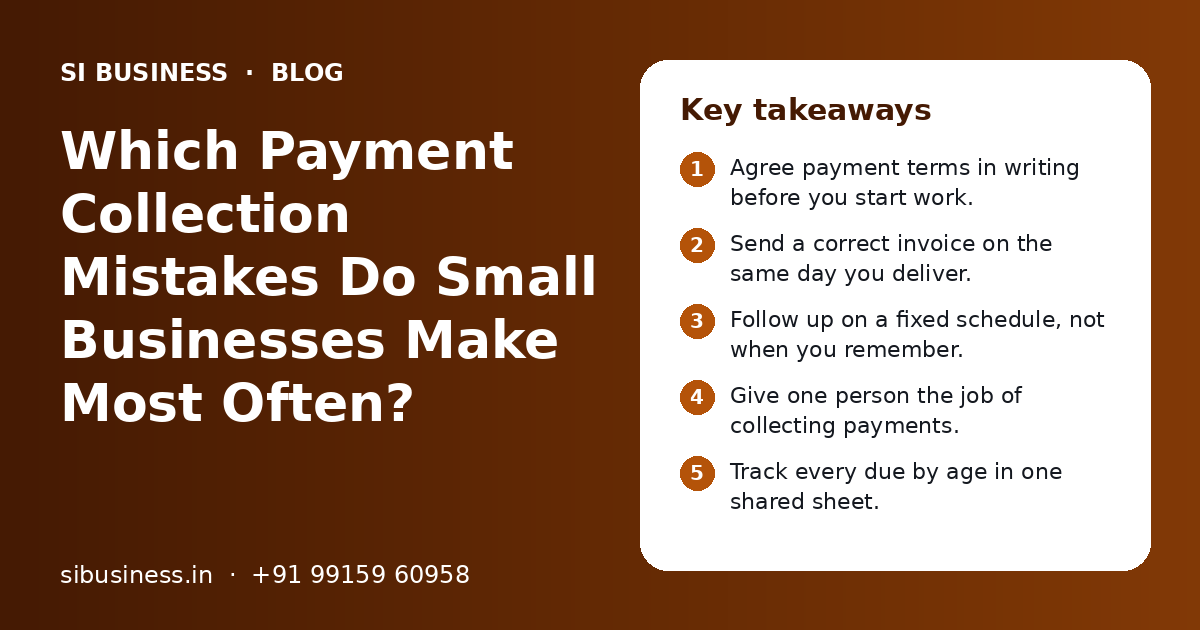
Key takeaways
- Agree payment terms in writing before you start work.
- Send a correct invoice on the same day you deliver.
- Follow up on a fixed schedule, not when you remember.
- Give one person the job of collecting payments.
- Track every due by age in one shared sheet.
- Stop extra credit for customers who keep paying late.
Why do small businesses struggle to collect payments on time?
Most small businesses struggle to collect payments because they have no fixed collection process. Terms are vague, bills go late and follow-up depends on the owner's free time.
In many Indian businesses, credit is part of how trade works. Distributors give goods on credit to shops, and service firms bill after the work is done. Credit itself is not the problem. The problem is when nobody manages it.
When this process is missing, sales look good on paper but the bank balance does not match. The good news is that most of the problem comes from a small set of mistakes that are cheap to fix. You need clear rules and one person who follows them.
What are the most common payment collection mistakes small businesses make?
The most common mistakes are unclear terms, late invoices, irregular follow-up, no owner for collection, no tracking by age and extra credit for slow payers. The table below shows each one with its effect and a simple fix.
| Mistake | What happens | Simple fix |
|---|---|---|
| No written payment terms | Customer decides when to pay | Write due date and terms on the quote and order |
| Invoice sent late | The customer's payment clock starts late | Send the invoice on the day of delivery |
| Wrong invoice details | Customer holds payment until it is corrected | Check GSTIN, PO number and amounts before sending |
| No reminder schedule | Follow-up happens only when cash is short | Set fixed reminder days before and after the due date |
| Only the owner collects | Collection stops when the owner is busy | Give one staff member clear ownership |
| No ageing view | Old dues are forgotten and become hard to recover | Track every due by how many days it is overdue |
| More credit for late payers | The amount at risk keeps growing | Set a credit limit and hold new orders above it |
| Payment is hard to make | Customer delays because paying takes effort | Add a UPI QR code or payment link to every bill |
Most businesses have two or three of these. Fix the ones holding the most money first.
Which mistakes happen before the sale is even made?
Many collection problems start before the first invoice. If the terms are not clear at the start, you have little to point to when the payment is late.
Mistake 1: Agreeing terms only by word of mouth
A salesperson says "pay when you can" to close a deal. Later, the customer takes that literally. Fix it by writing the payment terms on the quote, the order confirmation and the invoice. Use plain words, such as "50% advance, balance within 15 days of delivery". Keep the same terms on all three papers.
Mistake 2: Taking no advance on large or custom work
For custom orders or large first orders, ask for an advance. It covers materials and confirms the order.
Mistake 3: Giving credit to new customers without any check
Start new customers on advance or short credit. Increase credit only after a few orders are paid on time. Ask for their GSTIN, billing address and the name of the person who approves payments.
A clear customer onboarding process helps here. When every new customer goes through the same steps, credit terms, contacts and billing details are collected once and stored in one place.
Which billing mistakes delay payments?
Billing mistakes delay payments because the customer cannot pay a bill that is late, wrong or missing a detail their accounts team needs. Every correction restarts the wait.
Mistake 4: Raising the invoice days after delivery
Many customers count the credit period from the invoice date. If your bill goes a week late, your money comes a week late. Make the invoice part of the delivery step.
Mistake 5: Small errors in the invoice
A wrong GSTIN, a missing purchase order number or a rate that does not match the quote can stop payment. Use a short checklist before every invoice goes out.
- Customer name and billing address match their records
- Customer GSTIN is correct, where they are GST registered
- Purchase order or reference number is written on the bill
- Rates and quantities match the quote and delivery note
- Due date and payment terms are printed clearly
- Bank details, UPI QR code or payment link are on the bill
- Delivery proof or signed challan is attached where needed
Mistake 6: Sending the bill to the wrong person
The person who placed the order is often not the person who pays. Fix it by asking every customer for an accounts contact and sending bills to both people. A clear order management process links each order to the right billing contact, so this does not depend on memory.
Need help with your project?
Talk to the SI Business team. Free first call, simple advice, clear quote.
What follow-up mistakes keep payments stuck?
The biggest follow-up mistake is having no schedule. When reminders go out only when cash is tight, customers learn that your due dates are not serious.
Mistake 7: Leaving collection only to the owner
In many family businesses, only the owner calls customers about money. When the owner is busy, collection stops. Give one staff member this job, with a short script and clear limits. The owner steps in only for big or difficult cases.
Mistake 8: Feeling awkward about asking
Many owners worry that a reminder will upset a good customer. In practice, a polite reminder on a fixed day is normal business. Use the same polite messages for every customer, so nobody feels singled out.
Mistake 9: No fixed reminder routine
Use a simple schedule for every invoice. Here is one routine you can adapt to your own terms.
- 1
A few days before the due date
Send a friendly note with the invoice number, amount and due date.
- 2
On the due date
Send a short message that the payment is due today.
- 3
Soon after the due date
Call the accounts contact and ask for a payment date.
- 4
If the promised date is missed
Send a firm but polite written reminder.
- 5
If it stays unpaid for long
The owner calls a senior person and holds new orders.
- 6
If nothing works
Send a formal written notice and talk to your CA or lawyer about the next legal step.
Write this routine down as a one-page SOP so it does not change with each staff member. Our SOP documentation service can help you turn it into a clear written process.
How should you follow up on pending payments on WhatsApp and phone?
Keep payment reminders short, polite and specific. Always mention the invoice number, amount and date, and make paying easy with a link or QR code.
WhatsApp is how many Indian customers prefer to be reminded, and a written message gives you a record. Use WhatsApp Business labels such as "Payment due" and "Promised" so chats do not get lost. Write in the customer's own language if that is how you usually talk.
| Stage | Sample message |
|---|---|
| Before due date | Hello, a quick reminder that invoice 1045 for the order delivered last week is due on the 25th. The bill and payment link are attached. Thank you. |
| On due date | Hello, invoice 1045 is due today. Please share the payment reference once done, so we can update our records. Thank you. |
| After due date | Hello, invoice 1045 is now overdue. Please let us know if there is any issue with the bill. When can we expect the payment? |
| After a missed promise | Hello, you had confirmed payment of invoice 1045 by Monday. We have not received it yet. Please share a firm date today. |
On phone calls
- Call the accounts contact, not the person who placed the order.
- Ask for a specific date, not "soon" or "next week".
- Confirm the promised date on WhatsApp right after the call.
If WhatsApp is a big part of how you work, our page on WhatsApp business operations explains how to run it as a team process instead of one person's phone.
How do you track pending payments without software?
Track pending payments in one shared sheet with one row per unpaid invoice and a column that shows how many days each due is late. Review it every week.
| Column | What to write |
|---|---|
| Customer | Customer name and accounts contact |
| Invoice number and date | As printed on the bill |
| Amount due | The unpaid balance |
| Due date | Based on the agreed terms |
| Days overdue | Today minus the due date |
| Last follow-up | Date and channel of the last reminder |
| Promised date | What the customer last committed to |
| Owner and status | Who is following up, and open, promised, part paid or paid |
Mistake 10: Looking only at the total amount due
A large total that is mostly not yet due is fine. A smaller total that is mostly over 60 days late is a warning. Fix it by looking at the ageing groups every week, not just the total. Put the overdue amount on your KPI dashboard for owners so it gets the same attention as sales.
When should you stop giving credit to a customer?
Stop or reduce credit when a customer keeps missing due dates, breaks payment promises or goes over an agreed credit limit. Giving them more goods only raises the amount at risk.
A clear rule written in advance makes this easier, even when the customer is a big buyer. Staff can then follow the rule without asking the owner each time.
- Set a credit limit and a credit period for each regular customer
- Hold new orders when the customer crosses the limit
- Move customers to advance payment after repeated late payments
- Agree a written payment plan for large old dues
- Review the credit list every month with the owner and accountant
- Talk to your CA before writing off any amount
How can SI Business help fix your payment collection process?
We map how money moves from order to bank in your business, find where it gets stuck and set up a simple collection process your team can run. You get a clear quote after a free call.
Process review
We look at your terms, billing, reminders and tracking to find the gaps.
Clear rules
Written payment terms, credit limits and a reminder routine for your team.
Tracking set-up
An ageing sheet or dashboard that shows overdue amounts every week.
Automation where it helps
Automatic invoice sending and payment reminders by WhatsApp or email.
Once the basic process works, our finance process automation service can send bills and reminders on schedule, and a CRM keeps contacts, orders and dues together. An operations audit can review collection along with your other daily processes. To discuss your situation, book a free call.
Frequently Asked Questions
How do I politely ask a customer for a pending payment?
Send a short message with the invoice number, amount and due date, and attach the bill and a payment link or UPI QR code. Ask if there is any issue with the bill and request a date for payment. Keep the tone friendly and the facts clear. Using the same polite message for every customer makes it feel routine, not personal.
How often should I send payment reminders?
A simple routine works for most small businesses: one reminder a few days before the due date, one on the due date, a call soon after, and firmer reminders if a promised date is missed. The exact gap depends on your terms and customers. What matters most is that the routine is fixed and followed for every invoice.
Is it okay to send payment reminders on WhatsApp?
Yes. Many Indian customers prefer WhatsApp, and a written reminder gives you a clear record. Keep messages short and polite, mention the invoice number and amount, and attach the bill. Use a business number, not a personal one, so the chat stays with the business if staff change. Avoid sending reminders very late at night.
What is an ageing report in payment collection?
An ageing report lists unpaid invoices by how long they have been overdue, for example not yet due, up to 30 days late, 31 to 60 days late and over 60 days late. It shows which dues need urgent attention. Older dues are usually harder to collect, so they should be followed up first and reviewed every week.
How can I reduce outstanding payments without losing customers?
Agree clear terms at the start, send correct invoices on time, make paying easy, and follow a fixed reminder routine. Most good customers do not mind clear, polite reminders. Keep firmer steps, such as holding new orders, for customers who repeatedly miss dates. This protects your cash without upsetting the customers who pay well.
Can payment reminders be automated for a small business?
Yes. Many billing and accounting tools can send invoices and reminders by email, SMS or WhatsApp on fixed days. A CRM or simple workflow tool can also alert staff when a due crosses a set number of days. Set up the manual process first, then automate the steps that repeat. A person should still handle difficult cases.