Quick answer
How can a restaurant reduce food wastage every day?
To reduce food wastage in a restaurant, first track what you throw away each day and why. Then store stock by first in, first out, plan prep from your real sales pattern, fix portion sizes with standard recipes, remove dishes that waste a lot, and give one person the job of a daily waste log and weekly review.
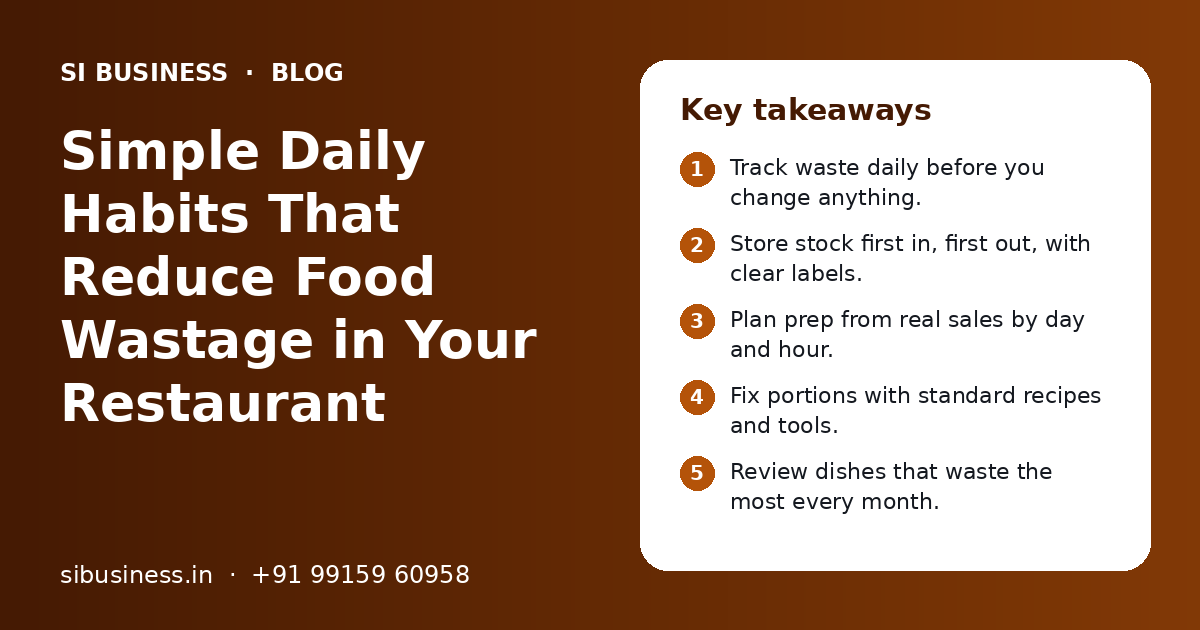
Key takeaways
- Track waste daily before you change anything.
- Store stock first in, first out, with clear labels.
- Plan prep from real sales by day and hour.
- Fix portions with standard recipes and tools.
- Review dishes that waste the most every month.
- Give one person the daily waste log job.
Why is there so much food wastage in a restaurant?
Most food wastage in a restaurant comes from the process, not from careless staff. Stock is ordered or prepped without a plan, stored in the wrong order, served in uneven portions, and nobody records what is thrown away.
Owners often notice the problem only when food cost feels high at month end. By then, nobody remembers what went into the bin.
- Too much gravy, rice or dough is prepped "just in case"
- Older stock sits at the back of the fridge and spoils
- Each cook serves a different portion of the same dish
- Some dishes sell rarely, but their ingredients are always stocked
- Guests leave large amounts on the plate and nobody asks why
- No one writes down what is thrown away, so nothing changes
The good news is that each of these is a process problem. A process can be written down, followed and checked. Our page on operations improvement by industry shows how this kind of thinking works for restaurants and other businesses.
Where does food waste happen in a restaurant kitchen?
Food waste happens at five main points: buying and receiving, storage, prep, cooking and serving, and the plate. Each point needs a different fix, so first find which ones hurt you most.
| Point | What goes wrong | Simple fix to try |
|---|---|---|
| Buying and receiving | Over-ordering, poor quality or short-dated items accepted | Order from a par level and check every delivery |
| Storage | Old stock hidden behind new stock, wrong temperature | FIFO rule, labels with dates, fixed places on shelves |
| Prep | Too much prepped for a slow day | Daily prep list based on past sales for that day |
| Cooking and serving | Burnt or wrong dishes, uneven portions | Standard recipes, portion tools, clear KOT notes |
| The plate | Portions too large, sides nobody eats | Watch returned plates and adjust portions or sides |
For buying, order only the gap between a set par level and current stock, and check every delivery before you sign. Our page on the vendor management process explains supplier rules and returns. If you are not sure where to start, a short operations audit can show the biggest gaps in one review.
How do you track food waste every day?
Keep a simple daily waste log near the bin or the pass. Every time food is thrown away, staff write the item, the quantity, the reason and the time. One person checks the log at day end.
You cannot reduce what you do not measure. A waste log turns a vague feeling into clear facts. After two or three weeks, you will see which items, which reasons and which days cause most of the waste.
- 1
Put the log where waste happens
Keep a printed sheet, a clipboard or a shared phone sheet near the main bin, the prep area and the pass.
- 2
Record four things
Item name, quantity (by weight, plates or portions), reason and time of day.
- 3
Use fixed reasons
Give a short list of reasons, such as spoiled, over-prepped, cooking mistake, returned by guest and plate waste.
- 4
Weigh where you can
A small kitchen scale near the bin makes the numbers more accurate than guesses.
- 5
Check it at closing
The shift lead or kitchen manager checks the log every night and adds anything missing.
- 6
Review it weekly
Look for the top items and top reasons, and pick one fix for the coming week.
Once the log is a habit, you can move it to a simple sheet or your POS and show it on a KPI dashboard for owners, next to sales and food cost.
How does FIFO storage reduce food wastage?
FIFO means first in, first out. Older stock is used before newer stock, so items do not sit at the back of the fridge or store until they spoil.
- Label every container with item name and date made or received
- Use a colour sticker or marker for each day of the week if staff find dates hard
- Put new stock behind or below old stock, never in front
- Give each item a fixed place on the shelf or in the fridge
- Check the fridge and dry store at opening for items close to expiry
- Move items near expiry to a "use first" tray
- Keep raw and cooked food apart and at the right temperature
FIFO is part of a wider stock process. Our page on the inventory management process explains how to set stock levels, count stock and keep records that match what is on the shelf.
Need help with your project?
Talk to the SI Business team. Free first call, simple advice, clear quote.
How should you plan prep based on your sales pattern?
Plan prep from what you actually sold on the same day in past weeks, not from habit. A written daily prep list with quantities for each item stops over-prepping on slow days and running out on busy days.
Weekday lunch is different from Saturday dinner, and festivals change the pattern too. Your POS already holds this data.
Build a prep list in five steps
- Pull item-wise sales from your POS for the same weekday over the last few weeks.
- Turn dish sales into prep quantities, for example how much base gravy or dough each dish needs.
- Write a prep list for each day with item, quantity and the person responsible.
- Prep in batches: a first batch before service and a smaller top-up batch if sales are strong.
- At closing, note what prep was left over and adjust the next week's quantities.
Cook in smaller batches
Large batches feel efficient, but leftover batches are a big source of waste. Smaller batches with a mid-shift check keep food fresh and cut day-end waste. Rice, dal and gravies are good items to batch this way.
Prep planning also helps speed. If your problem is late orders more than waste, our guide on how to reduce order delays in a restaurant kitchen covers prep for rush hours in more detail.
How can portion control cut food waste?
Portion control means every plate of a dish uses the same quantity of each ingredient. It cuts waste from oversized plates, keeps food cost steady and gives guests the same dish every time.
Without fixed portions, one cook serves a large ladle and another serves a small one. Guests get different plates, and food cost moves without any reason you can see.
- Write a standard recipe card for every dish with exact quantities
- Use fixed ladles, scoops, spoons and bowls for each dish
- Keep a scale at stations where meat, paneer or fish is portioned
- Put a photo of the correct plate at the pass
- Pre-portion costly items during prep, not during the rush
- Train new cooks on portions in their first week
Recipe cards and portion rules are a form of SOP. If you need help writing them in a way staff will follow, see our SOP documentation services.
Which menu changes help reduce food wastage?
Review your menu every month using your sales and waste log. Remove or change dishes that sell rarely but need special ingredients, and plan dishes that share the same base items.
A long menu means many ingredients in stock. When a dish sells only a few times a week, its special ingredients often spoil before they are used.
| Menu problem | What it causes | What to try |
|---|---|---|
| Slow dish with special ingredients | Ingredients spoil before use | Remove it, make it a special, or reuse the ingredient in other dishes |
| Too many gravies or bases | Many small batches, more leftovers | Use fewer base gravies across more dishes |
| Large fixed sides | Sides come back untouched | Make sides optional or smaller |
| Same dish in many portion sizes | Confusion and uneven portions | Keep one or two clear sizes |
| Seasonal items all year | Poor quality stock and more waste | Change the menu with the season |
Menu decisions should come from numbers, not guesses. Our data analytics for business decisions page explains how to read item-wise sales in a simple way.
What daily routine should restaurant staff follow to reduce waste?
Give staff a short routine with clear owners: a stock check at opening, a prep list before service, a mid-shift check during service and a waste log check at closing. When one person owns each step, it gets done.
| Time | Task | Owner |
|---|---|---|
| Opening | Check fridge and store, move near-expiry items to the use-first tray | Kitchen lead |
| Before service | Follow the daily prep list, label everything with date | Prep cooks |
| Mid-shift | Check prep levels, top up in small batches only if needed | Shift lead |
| During service | Use portion tools, note returned plates and reasons | Line cooks and service staff |
| Closing | Complete the waste log, store leftovers safely, note left-over prep | Shift lead |
| Weekly | Review the waste log and agree one fix | Owner or manager |
If you run more than one outlet, use the same routine and the same log format in every branch, as explained in our page on multi-branch operations management.
What mistakes stop restaurants from reducing food wastage?
The common mistakes are trying to fix everything at once, blaming staff, stopping the waste log after a few weeks, and making changes without checking the numbers again.
What works
- Start with one or two of the biggest waste items
- Make the waste log a normal part of closing
- Share weekly results with the whole team
- Change one thing at a time and measure again
What does not work
- Long rules that nobody reads
- Punishing staff for every item in the log
- Cutting portions sharply without telling guests
- Stopping the review once things look better
Reducing food wastage is not a one-time project. It is a daily habit backed by a weekly review. When you are ready to fix the wider process, our team can help with business process optimization for your kitchen and front of house. You get a clear quote after a free call.
Frequently Asked Questions
What is the easiest way to start reducing food wastage in a restaurant?
Start a daily waste log. Keep a sheet near the bin and ask staff to write the item, quantity, reason and time whenever food is thrown away. After two or three weeks, review it and pick the top one or two items to fix first. This simple habit shows you where money is being lost before you change anything else.
What is FIFO in a restaurant kitchen?
FIFO means first in, first out. Stock that came in first is used first. New deliveries go behind or below older stock, and every container has a label with the item name and date. It stops older stock from spoiling at the back of the fridge or store and keeps food fresh and safe for guests.
How do I know how much to prep each day?
Look at item-wise sales from your POS for the same weekday over the past few weeks. Turn dish sales into prep quantities and write a daily prep list. Prep a first batch before service and a smaller top-up batch only if sales are strong. At closing, note leftover prep and adjust the next list.
Does portion control mean giving guests less food?
No. Portion control means giving the same right amount every time. Standard recipes, fixed ladles and scoops, and a photo of the correct plate keep portions steady. If guests often leave food on the plate, the standard portion may be too large, and a smaller, steady portion can reduce waste while keeping guests happy.
Can software help reduce food wastage in a restaurant?
Yes, but only after the basic process works. A POS can show item-wise sales for prep planning, and inventory software can track stock, expiry and recipe usage. A simple sheet or dashboard can hold the waste log. Start with the paper routine first, then move it into software once the team follows it every day.
How often should a restaurant review food waste?
Check the waste log every night at closing and review it properly once a week. In the weekly review, look at the top items and reasons and agree one fix for the next week. Review the menu once a month using sales and waste together, and remove or change dishes that waste a lot.
How can a cloud kitchen reduce food wastage?
A cloud kitchen should plan prep from delivery app sales by day and hour, keep a short menu with shared base items, and use FIFO storage with clear labels. Fixed portions and packing checklists stop wrong or remade orders. A daily waste log and weekly review work the same way as in a dine-in restaurant.
Who should own food waste control in a small restaurant?
Give one person clear ownership, usually the kitchen lead or shift lead. They check stock at opening, follow the prep list, complete the waste log at closing and bring it to the weekly review. The owner or manager runs the review and agrees on fixes, so the habit does not depend on memory.