Quick answer
How can a distribution business reduce delivery delays?
To reduce delivery delays for a distribution business, set a fixed order cut-off time, plan routes by area the evening before, keep stock figures correct, check every load against the invoice before the van leaves, and send retailers a simple WhatsApp update. Track on-time deliveries, short supply and returns every day.
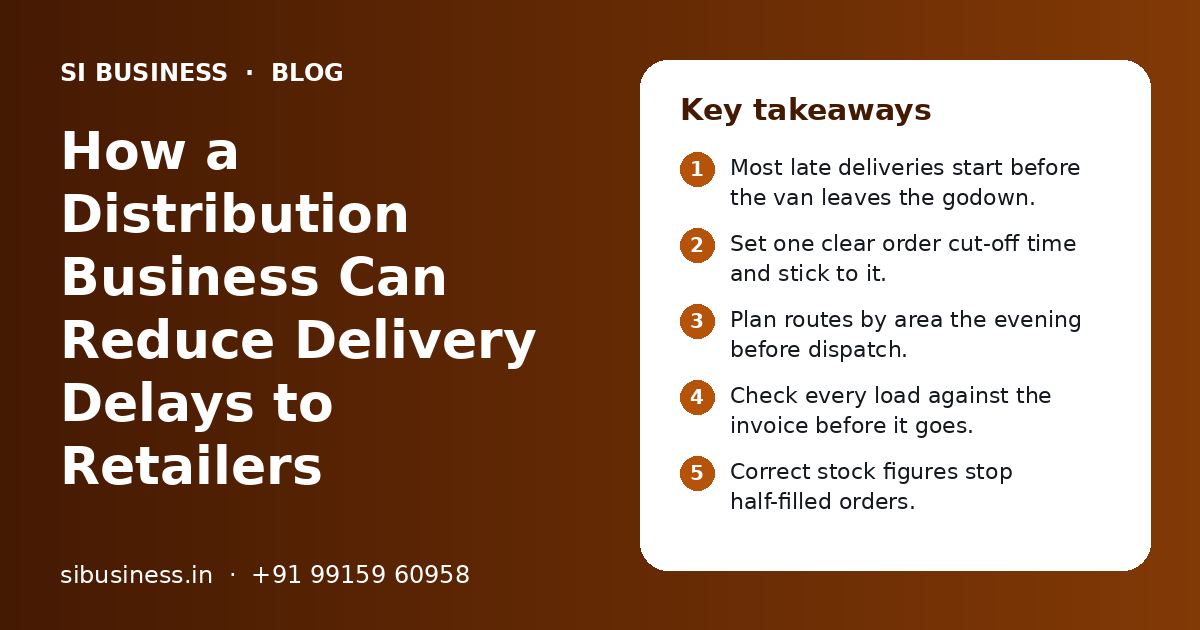
Key takeaways
- Most late deliveries start before the van leaves the godown.
- Set one clear order cut-off time and stick to it.
- Plan routes by area the evening before dispatch.
- Check every load against the invoice before it goes.
- Correct stock figures stop half-filled orders.
- Review five simple delivery numbers every day.
Why do deliveries get delayed in a distribution business?
Deliveries get delayed mainly because orders arrive late or unclear, stock in the system does not match the godown, loading starts late, and routes are planned on the spot. These are process gaps, so most of them can be fixed without buying more vans.
Think about a normal day at a small FMCG, pharma, hardware or electrical distributor. Salesmen send orders on WhatsApp late in the evening. The billing person types them the next morning. The godown team finds that two items are short. The van leaves at noon instead of nine. By evening, half the route is still waiting.
- Orders come in from many places and nobody knows the final list
- There is no fixed time after which orders go to the next day
- Stock shows in billing software but is not on the shelf
- Picking and loading start only after all bills are printed
- Drivers decide the route themselves every morning
- Retailers are not told when the goods will reach them
Each of these adds a little delay. Together, they push your deliveries back by hours. The good news is that each one has a simple fix. Our business process optimization work starts by finding which gap hurts your business the most.
Where does a delivery get stuck between order and drop?
A delivery can get stuck at six points: order taking, billing, picking, loading, the route and the drop at the shop. Measure each point on its own, because each needs a different fix.
| Stage | What causes the delay | Simple fix to try |
|---|---|---|
| Order taking | Orders come by calls, chats and diaries, often late at night | One order channel per salesman and a fixed cut-off time |
| Billing | Bills are typed in the morning in a rush | Bill all orders before the cut-off for the next day |
| Picking | Pickers search for items, stock is short | Fixed bin places and a daily stock check of fast items |
| Loading | Van loaded without a plan, items mixed up | Load by route order, last drop goes in first |
| Route | Driver decides the route on the day | Area-wise route plan made the evening before |
| Drop at shop | Retailer is closed, busy or refuses part of the order | Time slot shared on WhatsApp and proof of delivery |
A faster driver cannot fix a delay that starts at billing. Our page on the order management process explains how an order should move from the first message to final payment.
How do you set an order cut-off time that works?
Pick one fixed time after which new orders move to the next delivery day, tell every salesman and retailer, and follow it every day. A cut-off gives your billing and godown team enough time to prepare loads without a morning rush.
Many distributors fear that a cut-off will annoy retailers. In practice, retailers prefer a clear rule. They know that an order placed before the cut-off will reach them on time. Without the rule, every order is a guess.
- 1
Look at when orders arrive
For one or two weeks, note the time each order comes in. You will see when most orders arrive and which ones come very late.
- 2
Choose the cut-off
Set a time that leaves enough hours for billing, picking and loading before the vans leave. Many teams set it in the evening for next-day delivery.
- 3
Fix one order channel
Ask salesmen to send orders in one format, in one place, such as a sales app, a shared sheet or one WhatsApp group.
- 4
Tell everyone
Share the cut-off with salesmen and retailers in Hindi, Punjabi or the local language, and print it on the invoice.
- 5
Handle urgent orders separately
Keep a small, written rule for true emergencies, such as a second trip or a pickup from the counter.
How does correct stock help you deliver on time?
When the stock in your software matches the stock on the shelf, you only promise what you can deliver. Wrong stock figures lead to bills that cannot be picked, part orders, second trips and angry retailers.
Short supply is one of the most common reasons a delivery is late or incomplete. The bill is made, but the godown cannot find the item. The van waits, or leaves without it. A second trip is then needed later in the week.
- Enter every purchase on the day the goods arrive
- Keep fixed shelf or bin places for each item
- Count your fast-moving items every day or every week
- Record returns and damaged goods the same day
- Set reorder levels for items that sell every day
- Do not let staff move stock between godowns without an entry
Our page on the inventory management process explains receiving, counting and reorder levels in detail. Late supply from your own companies or suppliers also causes short stock, so fixed delivery days and follow-up rules from our vendor management process page help here too.
Need help with your project?
Talk to the SI Business team. Free first call, simple advice, clear quote.
How should a distributor plan delivery routes?
Group retailers by area, fix the days each area is served, and make the route plan the evening before dispatch. The driver should get a printed or phone list in drop order, not decide the route on the spot.
Steps to build a simple route plan
- Make a list of all your retailers with area, address, landmark and phone number
- Group them into areas that one van can cover in a day
- Fix the delivery days for each area and share them with retailers
- Each evening, sort the next day's bills by area and drop order
- Note shop timings and market closing days, which differ from market to market
- Keep the drop list with the driver and one copy at the office
A map app on the phone helps with traffic, but your own area knowledge matters more. Narrow lanes, loading rules in busy markets and shop timings change the best order of drops. If you run more than one godown or branch, our page on multi-branch operations explains how to keep one routine across all of them.
What should a dispatch checklist include?
A dispatch checklist should confirm that every item and quantity on the invoice is in the van, that the load order matches the route, and that the driver has invoices, the drop list and any e-way bill needed. One check before the van leaves saves many calls later.
Wrong items and missing cartons are found at the shop, not in the godown. Then the retailer refuses part of the order, the driver calls the office, and the whole route slows down.
- Every invoice in the load is printed or shared and signed off
- Items and quantities are checked against each invoice
- Cartons are marked with the retailer name or invoice number
- Load order matches the route, with the last drop loaded first
- E-way bill is ready where it is needed for the load
- Driver has the drop list, retailer phone numbers and collection details
- Van leaving time is noted in the register or app
Write this checklist as a one-page SOP and put it on the godown wall. Our page on SOP documentation shows how to write steps your godown team will actually follow, in the language they read best.
How can WhatsApp updates reduce calls about late deliveries?
A short WhatsApp message when the order is billed and when the van leaves tells the retailer what to expect. Fewer retailers call to ask where the goods are, and your office team gets more time for real work.
Most retailers in India already order and pay on WhatsApp and UPI. Use the same channel for delivery updates. Keep the messages short and the same every time.
- Order received: items, quantity and the planned delivery day
- Out for delivery: van number or driver name and a rough time slot
- Delivered: invoice number, amount and a photo of the signed copy
- Short supply: which item is short and when it will come
Tell the retailer about short supply before the van reaches the shop, not at the counter. An early message keeps trust. Our page on WhatsApp business operations explains shared numbers, templates and chat ownership for growing teams.
Which numbers should a distributor track every day?
Track on-time deliveries, orders delivered in full, van leaving time, returns or refusals at the shop, and pending deliveries carried to the next day. Review them each morning with the godown head and the dispatch team.
| Number | What it tells you |
|---|---|
| Deliveries on time out of total | Whether your routine is working |
| Orders delivered in full | Whether stock and picking are correct |
| Van leaving time | Whether billing and loading finish on time |
| Returns or refusals at the shop | Whether wrong items or poor checks are a problem |
| Deliveries carried to the next day | Whether routes are overloaded |
Look at these numbers by van, by area and by salesman. Patterns show up quickly. One area may always be late because the route is too long. One salesman may always send orders after the cut-off. A short daily team huddle is a good place to talk about these numbers, and a simple KPI dashboard for business owners can show them on one screen.
What mistakes make delivery delays worse, and how can SI Business help?
The biggest mistakes are accepting orders at any time, trusting stock figures nobody has checked, and buying route or delivery software before the basic routine is fixed. Each one adds confusion for the team and waiting for the retailer.
- No order cut-off, so billing and loading start late every day
- Owner taking orders on personal calls that never reach billing
- No check before the van leaves, so errors are found at the shop
- Changing routes every day without telling retailers
- Changing many things at once, so nobody knows what worked
How SI Business can help
We study your order flow from the first message to the final drop, find where the delays start, and help your team fix them with a cut-off, route plans, dispatch checks, stock routines and daily numbers. If you want an outside review first, an operations audit covers orders, godown, dispatch and tools in one study. SI Business is powered by Shivah Web Tech, with 11+ years of work and 500+ projects, from our office in Mohali, Punjab. Cost depends on the number of godowns, vans, routes and the tools you already use, so you get a clear quote after a free call. Book a free call to start.
Frequently Asked Questions
Why are my distribution deliveries always late even with enough vans?
Most delays start before the van leaves. Orders arrive late, bills are typed in the morning, stock is short and loading has no plan. More vans do not fix these gaps. Note the van leaving time for two weeks and find what makes it late. Fix that first, then look at routes.
What is a good order cut-off time for a distributor?
There is no single right time for every business. It depends on your number of orders, how long billing and loading take, and when vans must leave. Look at when your orders arrive and how long preparation takes. Then set a cut-off that leaves enough time, and follow it every day.
Do I need route planning software for a small distribution business?
Not at the start. A list of retailers grouped by area, fixed delivery days and a drop list made the evening before can solve most route problems. Route software helps when you have many vans and many drops each day, but only after the basic plan is clear and followed.
How do I handle urgent orders without breaking the cut-off rule?
Write a small, clear rule for urgent orders. For example, allow them only for key retailers or for true stock-outs, and serve them with a counter pickup or a planned second trip. Let only one person approve them. If urgent orders become daily, your cut-off time or stock levels need review.
How can I reduce part deliveries and short supply?
Keep stock figures correct with same-day entries for purchases and returns, regular counts of fast-moving items and reorder levels. Check stock before you confirm an order. When an item is short, tell the retailer on WhatsApp before the van arrives and share when the balance will come.
What is proof of delivery and why does it matter?
Proof of delivery is a record that the retailer received the goods, such as a signed invoice copy or a photo. It reduces disputes about missing items, helps with payment follow-up and shows exactly when each drop happened. Save it the same day so it is not lost.
How long does it take to reduce delivery delays?
Simple changes such as a cut-off time, a dispatch checklist and WhatsApp updates can start within days. Correct stock figures and stable route plans take a few weeks of steady routine. Track your daily numbers so you can see which change worked and what to fix next.