How to Run a Daily Team Huddle That Stops Small Problems Early
Many delays start small. A missing part, a late report or a customer call that no one returned. A short daily team huddle catches these problems early, when they are still easy to fix. This guide shows you how to run one in about 15 minutes, in a shop, clinic, factory or office.
How do you run a daily team huddle that actually cuts delays?
To run a daily team huddle that cuts delays, meet at the same time every day for about 15 minutes, standing near the work. Look at a few numbers from yesterday, list today's priorities, raise blockers and give each problem one owner and a deadline. Solve big problems after the huddle, not during it.
Key takeaways
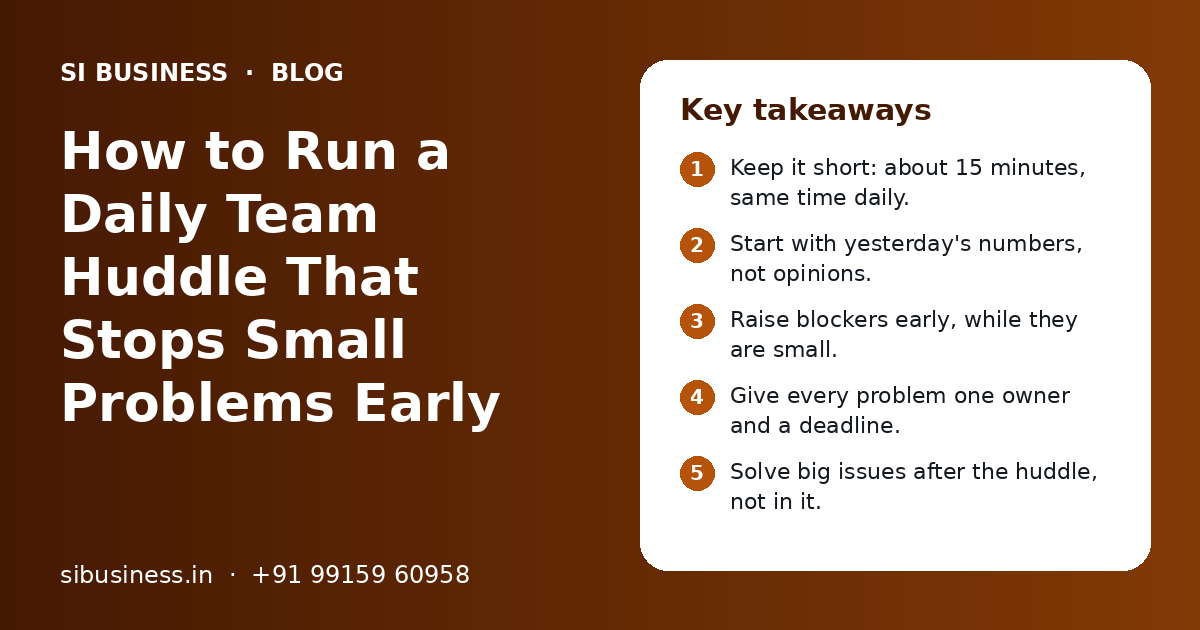
- Keep it short: about 15 minutes, same time daily.
- Start with yesterday's numbers, not opinions.
- Raise blockers early, while they are small.
- Give every problem one owner and a deadline.
- Solve big issues after the huddle, not in it.
- Track open actions on one simple board.
What is a daily team huddle and why does it cut delays?
A daily team huddle is a short, standing meeting at the start of the day or shift. It cuts delays because problems are raised within a day, not after a week, and each one gets a clear owner.
Most delays in a small business come from many small waits, not one big failure. A file waits for a signature. An order waits for stock that no one ordered. Together, these waits make customers unhappy.
When you learn how to run a daily team huddle well, these waits come out into the open every morning. The team sees them together, and someone takes charge of each one. This is much faster than finding out at the end of the month.
Who should attend the daily huddle?
The people who do the work and the person who leads that team should attend. Keep the group small, usually one team or one area, so everyone can speak and the huddle stays short.
If you have many teams, run one huddle per team. Then the team leads can meet for a short second huddle to share issues that cross teams. This is called a tiered huddle.
| Type of business | Who attends | Good time |
|---|---|---|
| Retail shop or showroom | Counter staff, store manager, stock person | Before the shop opens |
| Clinic or diagnostic centre | Front desk, nurses, doctor or clinic manager | Before the first appointment |
| Factory or workshop | Shift supervisor, line leads, quality and stores | At the start of each shift |
| Office or service firm | Team members and the team lead | First thing in the morning |
| Warehouse or dispatch | Pickers, packers, dispatch lead | Before the first pickup |
The owner does not need to attend every huddle. It often works better when the team lead runs it. If your business runs from more than one location, our guide on multi-branch operations explains how each branch can run its own huddle and share key numbers.
What should a daily huddle agenda include?
A good daily huddle agenda has four parts: yesterday's numbers, today's priorities, blockers and open actions. Use the same order every day so people come prepared.
| Part | Question to ask | Time |
|---|---|---|
| 1. Yesterday's numbers | Did we hit our targets yesterday? If not, why? | 3 to 4 minutes |
| 2. Today's priorities | What must be done today? Any urgent orders, patients or deadlines? | 3 to 4 minutes |
| 3. Blockers | What is stopping work? What do you need from someone else? | 4 to 5 minutes |
| 4. Open actions | Are the actions from earlier days closed? | 2 to 3 minutes |
Keep safety and quality as a standing item
In a factory, kitchen or clinic, add one short question at the start: did anything unsafe or any quality problem happen yesterday? This takes less than a minute and keeps safety in front of everyone.
What to leave out
Leave out long reports, salary topics and detailed problem solving. These need their own meeting.
How to run a daily team huddle, step by step
Pick a fixed time and place, prepare a few numbers, follow the agenda, and close with a clear list of owners and deadlines. Then follow up on those actions the next day.
- 1
Fix the time and place
Choose the same time every day and meet near the work, such as the shop floor, the counter or a board on the office wall. Start on time, even if one person is late.
- 2
Choose a huddle leader
Usually the team lead or supervisor. Their job is to follow the agenda, keep time and stop long discussions.
- 3
Prepare yesterday's numbers
Before the huddle, the leader writes down three to five numbers from yesterday, such as orders dispatched, patients seen on time or jobs finished.
- 4
Go round the team quickly
Each person shares today's main task and any blocker. One or two sentences each is enough.
- 5
Write down every blocker
Put each blocker on the board with one owner and a deadline. If it needs long discussion, note it and fix it after the huddle with only the people needed.
- 6
Review open actions
Check the actions from earlier days. Mark the closed ones. Ask the owner of any late action what help they need.
- 7
End on time
Close the huddle in about 15 minutes. Repeat the top priority for the day so everyone leaves with the same focus.
The most important step is the follow-up. If actions are written down but never checked, the team stops raising problems. If our SOP documentation team helps you, the huddle format itself can be written as a one-page SOP so any lead can run it the same way.
Which numbers should you review in a daily huddle?
Review three to five simple numbers that show whether yesterday's work was done on time and right. Each number should be easy to count and owned by someone in the room.
Choose numbers the team can change by its own work. A sales team cannot change the delivery time, so do not ask them about it. Here are examples by type of business.
| Business | Example daily numbers |
|---|---|
| Shop or showroom | Bills made, items out of stock, customer returns, pending home deliveries |
| Clinic | Patients seen on time, average waiting time, reports pending, missed calls |
| Factory | Units produced against plan, rejected pieces, machine stoppages, late material |
| Office or service firm | Tasks closed, tasks overdue, client replies pending, new enquiries |
| Ecommerce or dispatch | Orders shipped same day, orders on hold, returns received |
Use simple colours: green for on target, red for off target.
Over time, these daily numbers can feed a weekly owner view. Our page on the KPI dashboard for business owners shows how to turn daily counts into a short weekly report.
What does a good huddle board look like?
A good huddle board shows the daily numbers, today's priorities and a list of open actions with owner and date. It can be a whiteboard, a printed sheet or a shared screen.
- Three to five numbers from yesterday, with targets
- Today's top priorities, written in short words
- A blocker list with one owner and one deadline for each item
- A column for open actions and a column for closed ones
- Large, clear writing that can be read from a few steps away
For a single location, a whiteboard is often the best choice. Everyone can see it all day, and changing it takes seconds. Take a photo at the end of each huddle and share it in the team's WhatsApp group so people on leave or on another shift can see it.
For teams in more than one place, a shared sheet or a simple task tool works better. If your team already lives on WhatsApp, see our page on WhatsApp business operations for ways to keep team updates clear and separate from customer chats.
How do you keep the huddle short and useful?
Keep it short by standing up, following the same agenda every day and moving long discussions to a separate meeting. The leader must stop any topic that runs past a minute or two.
Habits that keep it useful
- Starting on time, every time
- Standing, not sitting
- Talking about facts and numbers
- Writing every action with an owner
- Thanking people who raise problems early
Habits that kill it
- Waiting for the owner or a late person
- Solving one problem while everyone watches
- Blaming people for bad numbers
- Skipping it on busy days
- Never checking old actions
Avoid blame. If a person is scolded for a red number, people will hide problems. Ask "what got in the way?" instead of "who did this?".
What mistakes should you avoid with daily huddles?
The most common mistakes are making the huddle too long, having no numbers, not following up on actions and letting the owner do all the talking. Each one turns the huddle into a routine that no one values.
- Letting the huddle grow past 15 to 20 minutes.
- Talking about feelings and opinions instead of yesterday's numbers.
- Writing actions without a single named owner.
- Giving an action to "the team" or "everyone".
- Not checking old actions, so the same problem comes up every day.
- The owner or manager talking most of the time while the team listens.
- Changing the format every week, so no one knows what to prepare.
If the same blocker comes up again and again, the huddle has done its job. It has shown you a process problem. Now that process needs a proper fix. An operations audit can help you find the root cause of repeat delays and decide what to change first.
How long does it take for daily huddles to work?
Most teams find the format awkward for the first week or two and then settle into it. You will usually see blockers raised earlier within a few weeks, as long as actions are followed up.
| Stage | What usually happens | What the leader should do |
|---|---|---|
| First week | Huddles run long, people are unsure what to say | Stick to the agenda and keep time strictly |
| Weeks two to four | Numbers become regular and blockers start coming out | Close actions quickly to build trust |
| After a month or two | Repeat problems become clear | Pick the top repeat problem and fix the process behind it |
| Ongoing | The huddle becomes part of the day | Drop numbers that no longer help |
Give it at least a month with the same format before you judge it. Then change one thing at a time.
Once the huddle is steady, it becomes the natural place to start other improvements. Many of the ideas on our business process optimization page begin with a blocker first raised in a daily huddle.
How can SI Business help you set up daily huddles?
We help you design the huddle format, choose the right daily numbers, set up a simple board and train team leads to run it. We then use what the huddles show to fix the processes behind repeat delays.
Huddle design
Agenda, timing and attendees for each team or shift.
Daily numbers
Three to five clear numbers per team, with targets and owners.
Board and tools
A whiteboard layout, a shared sheet or a simple digital board.
Lead training
Coaching for team leads on keeping huddles short and fair.
SI Business is powered by Shivah Web Tech, with 11+ years of experience, a 25+ in-house team and 500+ projects, from our office in Mohali, Punjab. We work with shops, clinics, factories and offices in India and abroad. We do not publish fixed prices. You get a clear quote after a free call, based on the number of teams, shifts and locations. Book a free call to get started.
Related Pages
Owner KPI Dashboard
One screen with the few numbers that tell you how the business is doing.
Process Optimization
Map, simplify and speed up the way key work gets done.
SOP Documentation
Clear, short SOPs so every task is done the same right way.
Operations Audit
A clear check of where time, money and customers are being lost.
Frequently Asked Questions
How long should a daily team huddle be?
A daily team huddle should usually be about 10 to 15 minutes. It should never become a long meeting. If a topic needs more time, write it down, give it an owner and discuss it after the huddle with only the people who are needed. Short huddles are easier to keep up every day.
What is the difference between a huddle and a normal meeting?
A huddle is short, happens every day at the same time, follows a fixed agenda and is usually held standing near the work. A normal meeting is longer, happens less often and is used for planning or solving one problem in depth. The huddle finds problems. Other meetings solve the bigger ones.
What time of day is best for a team huddle?
The best time is at the start of the working day or the start of each shift, before customers or patients arrive. This lets the team plan the day with fresh information. Pick one fixed time and keep it. Changing the time often makes people miss the huddle or come unprepared.
Should the business owner run the daily huddle?
It is usually better if the team lead or supervisor runs it. When the owner runs it, staff often wait for the owner to decide everything. The owner can attend now and then, read the board or join a weekly review. This helps the team take charge of its own daily problems.
Can we run a daily huddle on WhatsApp or a video call?
Yes, if the team works in different places. Keep the same agenda and time limit. Share the numbers before the call so people can see them. A written WhatsApp update can work for very small teams, but a short live call is better because blockers get discussed and owned at once.
What should we do if the same problem comes up every day?
A problem that repeats every day is a process problem, not a huddle problem. Stop discussing it in the huddle. Give it to one owner, set a date and look for the root cause, such as a missing step, unclear rule or wrong stock level. Fix that process, then check if the problem stops.
Do daily huddles work in a small shop with only a few staff?
Yes. Even a team of three or four people gains from a five to ten minute talk before opening. You can check yesterday's sales, today's deliveries, stock that is running low and any customer issues. Small teams often find that a short huddle stops many phone calls later in the day.
Talk to our team today
Call or WhatsApp +91 99159 60958. We reply fast, Monday to Friday.