Quick answer
How can a clinic, salon or service business reduce appointment no-shows?
To learn how to reduce appointment no-shows, start by tracking who misses and why. Then send WhatsApp or SMS reminders before each visit, make it easy to cancel or move a slot, take a small deposit for long or high-value bookings, keep a waitlist to refill gaps, and review your no-show numbers every week.
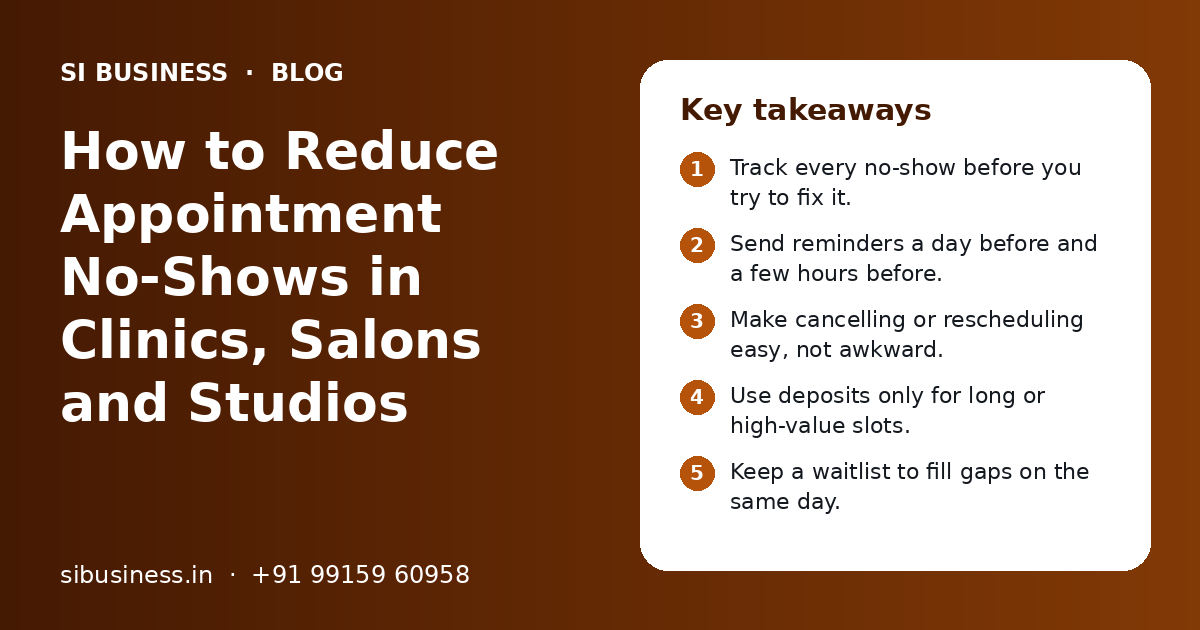
Key takeaways
- Track every no-show before you try to fix it.
- Send reminders a day before and a few hours before.
- Make cancelling or rescheduling easy, not awkward.
- Use deposits only for long or high-value slots.
- Keep a waitlist to fill gaps on the same day.
- Review no-show numbers with your team every week.
What is an appointment no-show and why does it hurt?
A no-show is a customer who books a slot and does not come, without telling you in time. It hurts because the time cannot be sold again, and staff are paid while they wait.
For a clinic, a missed slot means the doctor sits idle while other patients wanted that time. For a salon, a missed bridal trial or hair colour booking can block a stylist for hours.
No-shows also hide other problems. If many people miss slots, it may mean bookings are made too far ahead, reminders are weak, or customers do not feel the visit is important. Learning how to reduce appointment no-shows is really about fixing the booking process from start to end.
Why do customers miss appointments?
Most people miss appointments because they forget, their plans change and cancelling feels hard, or they booked too far ahead. Very few skip on purpose.
Knowing the reason matters, because each reason needs a different fix.
| Reason | What it looks like | Best fix |
|---|---|---|
| Forgot the booking | Booked weeks ago, no message since | Reminders a day before and on the day |
| Plans changed | Customer wanted to cancel but did not call | One-tap cancel or reschedule link on WhatsApp |
| Could not reach you | Phone busy or not answered | Shared WhatsApp number and call-back slot |
| Low commitment | Free booking, easy to ignore | Small deposit or prepaid booking for long slots |
| Confusion about time or place | Wrong branch, wrong day | Clear message with date, time, address and map link |
| Long wait last time | Customer expects delay and comes late or not at all | Fix waiting time and give honest delay updates |
How do you track no-shows before fixing them?
Record every booking with its outcome: came, came late, cancelled in time, cancelled late or no-show. Two to four normal weeks of records show you the pattern.
You can use a simple sheet, your booking software or your CRM. What matters is that every booking gets an outcome, every day, by one named person.
- 1
Set clear outcome labels
Use the same five labels every day: came, late, cancelled in time, cancelled late and no-show. Write down what "late" and "in time" mean for your business.
- 2
Name one owner
Make one front desk person responsible for marking outcomes before closing time.
- 3
Add useful details
Note the service type, staff member, day, time slot, how the booking came in and how many days ahead it was made.
- 4
Collect two to four weeks
Pick normal weeks without festivals or special offers, so the numbers reflect a usual period.
- 5
Find the pattern
Look for which days, slots, services and booking sources have the most no-shows.
- 6
Pick one fix to test
Start with the biggest pattern, change one thing and measure again.
If you want an outside view of your whole booking flow, an operations audit looks at bookings, staff roles and tools together.
How should you send appointment reminders on WhatsApp and SMS?
Send a confirmation when the booking is made, a reminder the day before and a short reminder a few hours before. Each message should include an easy way to confirm, cancel or move the slot.
In India, most customers read WhatsApp messages quickly, so it is usually the main channel. SMS is a useful backup for customers who do not use WhatsApp or have not agreed to WhatsApp messages.
| Message | When to send | What to include |
|---|---|---|
| Booking confirmation | Right after booking | Date, time, service, staff name, address and map link |
| Day-before reminder | The evening before | Time, a reply option to confirm, and a cancel or move link |
| Same-day reminder | A few hours before | Short note with time and any instructions |
| Missed you message | After a no-show | Polite note with a link to rebook |
Tips for reminder messages that work
- Keep each message short, with the time in the first line
- Write in Hindi, Punjabi or the local language your customers prefer
- Ask for a simple reply, such as 1 to confirm and 2 to reschedule
- Send from one business number, not staff personal phones
- Message only customers who agreed to get updates from you
For a busy business, reminders should go out on their own from your booking system, not by hand. Our page on WhatsApp business operations explains shared inboxes, templates and one number for the whole team. Our business automation work can connect bookings to reminders so nobody has to remember to send them.
Should you take a deposit to reduce no-shows?
A deposit works well for long, high-value or hard-to-refill slots, such as bridal makeup, hair colour, dental procedures or full-day services. For short, regular visits, a deposit can push people away.
When a customer has paid even a small amount, the booking feels more real. UPI makes this easy in India. You can send a payment link or QR on WhatsApp, and the booking is confirmed once payment comes in.
When deposits help
- Long slots that block a staff member for hours
- Services that need special preparation or stock
- Peak days such as weekends and festival season
- New customers booking high-value services
When deposits can hurt
- Short, low-value or routine visits
- Loyal regular customers who rarely miss
- Urgent medical or care visits
- When the refund or adjustment rule is unclear
- When staff cannot check payments quickly
Keep the rule simple and written. Say how much is taken, whether it is adjusted in the final bill, and what happens if the customer cancels in time or late. Show the rule at booking, in the confirmation message and at the counter. Issue a proper receipt, and include the amount in your GST bill where it applies.
Need help with your project?
Talk to the SI Business team. Free first call, simple advice, clear quote.
How does a waitlist help fill missed slots?
A waitlist is a list of customers who want an earlier or specific slot. When someone cancels, you message the waitlist and fill the gap quickly.
Without a waitlist, a cancellation at 10 in the morning usually becomes an empty 2 pm slot. With one, the front desk can send a short WhatsApp message and offer the slot to the first person who replies.
- Ask customers at booking if they want an earlier slot if one opens
- Keep the waitlist by service type and by preferred time
- Send one clear message to a few waitlist customers at once
- Give the slot to the first confirmed reply
- Clear old names from the list every week
A waitlist also works for walk-ins. Clinics and salons can keep a few walk-in names ready and call them in when a booked customer does not arrive. Our guide on reducing patient waiting time in clinics shows how to plan booked and walk-in slots together.
What no-show and cancellation rules should you set?
Set a clear, fair rule for late cancellations and repeat no-shows, write it down, and apply it the same way for everyone. Customers accept rules that are simple and told in advance.
What a simple rule covers
- How much notice counts as cancelling in time
- What happens to a deposit after a late cancellation or no-show
- How many no-shows lead to prepaid-only booking
- When staff can make an exception, such as illness or emergency
- Who is allowed to approve exceptions
Be kind in tone. A first no-show often needs only a polite message and an easy way to rebook. Repeat no-shows can move to prepaid bookings.
Write the rule into your front desk SOP so every staff member explains it the same way. Our page on SOP documentation explains how to write steps your team will follow.
What mistakes make appointment no-shows worse?
The biggest mistakes are sending reminders by hand when staff are busy, making cancelling hard, and overbooking to cover no-shows. Each one adds stress without solving the cause.
- Sending reminders only when someone remembers
- Making customers call to cancel when the phone is always busy
- Overbooking every slot and then crowding the waiting area
- Not tracking outcomes, so nobody knows if things improved
- Using staff personal phones, so messages and records get lost
- Shaming customers who miss, instead of making it easy to rebook
- Leaving the daily booking check to nobody in particular
Which numbers should you review every week?
Review the no-show rate, late cancellations, slots refilled from the waitlist and reminder confirmations. Look at them by day, service and staff member.
| Number | What it tells you |
|---|---|
| No-show rate | Whether your overall changes are working |
| Late cancellations | Whether customers can reach you in time |
| Reminder confirmation replies | Whether customers read and act on reminders |
| Slots refilled from the waitlist | Whether gaps are being filled |
| Repeat no-show customers | Who should move to prepaid booking |
A simple KPI dashboard for owners can show these numbers on one screen. Pick one change for the next week, then check if the number moved.
No-shows are also a sign of how customers feel about you. Good follow-up after visits, as part of a customer retention strategy, makes people more likely to keep their next booking.
How can SI Business help you reduce no-shows?
We study your booking process, find where no-shows start, and set up reminders, waitlists, rules and weekly tracking that fit your team.
Booking study
We look at your real booking and outcome data to find patterns.
Process and rules
We set clear reminder timing, cancel rules and front desk roles.
Tools and automation
We connect bookings with WhatsApp or SMS reminders and simple tracking.
Review and training
We train staff and review the numbers with you after go-live.
SI Business is powered by Shivah Web Tech, with 11+ years of work and 500+ projects, from our office in Mohali, Punjab. This work is part of our customer experience and workflow automation services. Cost depends on your number of staff, branches, services and the tools you already use, so you get a clear quote after a free call. Book a free call to start.
Frequently Asked Questions
What is a normal no-show rate for a clinic or salon?
There is no single number that fits every business, because it depends on the service, the city, how far ahead people book and whether you take deposits. A better approach is to measure your own rate for a few normal weeks. Then set a goal to bring it down step by step, and check each week if your changes are working.
Do WhatsApp reminders really reduce no-shows?
Reminders help most when people forget, which is the most common reason for missed appointments. WhatsApp works well in India because most customers check it often. The reminder should be short, sent at the right time and include an easy way to confirm or reschedule. Reminders alone will not fix every no-show, so combine them with clear rules and a waitlist.
How many reminders should I send before an appointment?
Most businesses do well with a confirmation at booking, one reminder the day before and a short one a few hours before the visit. For bookings made weeks ahead, add one more reminder a few days before. Too many messages can annoy customers and get ignored, so keep each message useful and test what works for your customers.
Is it okay to charge a deposit for appointments in India?
Yes, many salons, studios and some clinics take a booking amount, usually through UPI. Keep the rule clear and fair. Tell the customer how much is taken, whether it is adjusted in the final bill and what happens if they cancel in time or late. Give a proper receipt and handle it correctly in your GST billing where GST applies.
What software do I need to reduce appointment no-shows?
You need a booking system that records every appointment, sends reminders on its own and lets you mark outcomes. Many businesses start with a simple booking tool linked to WhatsApp or SMS. As you grow, a CRM or practice management system can add waitlists, deposits and reports. Choose software after you have fixed your process, so you buy only what you need.
How do I handle a customer who misses appointments again and again?
Send a polite message after each missed visit with a link to rebook. If the pattern continues, explain your rule and move them to prepaid or confirmed-only booking. Be respectful and keep notes in your records so all staff treat the customer the same way. For medical visits, make sure the rule does not stop someone from getting needed care.
How long does it take to see fewer no-shows?
Simple changes such as reminders and an easy cancel option can show results within a few weeks. Deposits, waitlists and new rules need some weeks for customers and staff to get used to them. Track the numbers every week from the start, and change one thing at a time so you can see clearly what made the difference.