Quick answer
Cycle count vs full stock count: which is better for a small business?
In the cycle count vs full stock count choice, a full count checks every item on one day, often with the business closed. A cycle count checks a small set of items on a fixed schedule, so all stock gets counted over time without stopping work. Many businesses use cycle counts through the year and one full count a year.
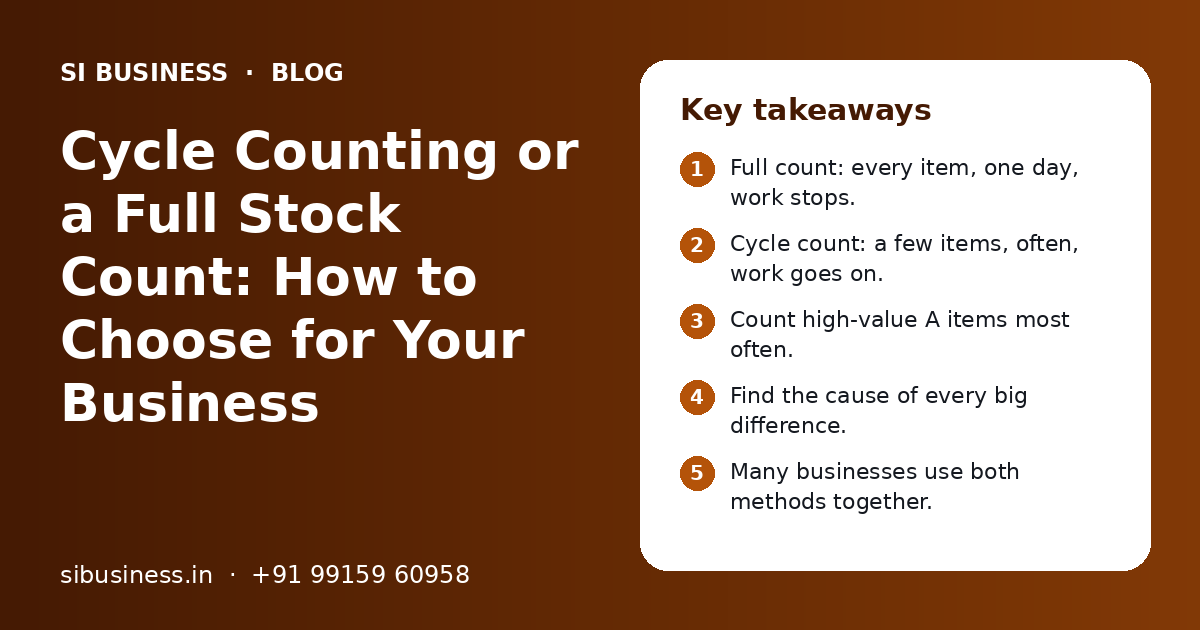
Key takeaways
- Full count: every item, one day, work stops.
- Cycle count: a few items, often, work goes on.
- Count high-value A items most often.
- Find the cause of every big difference.
- Many businesses use both methods together.
- Fix the process, not only the number.
Cycle count vs full stock count: what is the difference?
A full stock count means you count every item in the shop, godown or factory at one time. A cycle count means you count a small group of items on a fixed schedule, so the whole stock gets counted over weeks or months.
Neither method is useful on its own if stock is not recorded well every day. A clear inventory management process for receiving, issuing, returns and transfers is the base for any kind of count.
How do you run a full stock count step by step?
Plan the date, freeze stock movement, count every location in teams, compare with the system and approve the adjustments. Good preparation decides how smooth the day goes.
- 1
Fix a date and tell everyone
Pick a slow day, a Sunday or the end of the financial year. Tell customers, suppliers and staff that sales and receiving will stop for that time.
- 2
Finish all pending entries
Make sure every bill, purchase, return and transfer is entered in the software before the count starts.
- 3
Freeze stock movement
No goods come in or go out during the count. If something must move, write it on a separate sheet.
- 4
Make count teams of two
One person counts and one writes or scans. Give each team a fixed area so nothing is counted twice or missed.
- 5
Count without seeing the system figure
Give teams a sheet with item names but no quantities. This is called a blind count, and it stops people from writing what they expect.
- 6
Compare and recount
Compare the counted figures with the system. Recount items where the difference is large before you accept any figure.
- 7
Approve and post adjustments
The owner or a senior person approves each adjustment. Then the stock is updated in the software and the reasons are noted.
How do you run a cycle count step by step?
Group your items, set how often each group is counted, make a daily or weekly count list and count a few items at a time without stopping work. Then check and fix every difference quickly.
- Pull an item list with quantity sold and value from your billing or accounting software.
- Sort items into A, B and C groups (explained in the next section).
- Set a count schedule, for example A items every month, B items every quarter, C items twice a year.
- Split the list so each day or week has a small, fixed number of items to count.
- Count at a quiet time, such as the first hour of the day, before goods start moving.
- Use a blind count sheet or a mobile scan app, so the counter does not see the system figure.
- Compare with the system the same day and recount any item with a large gap.
- Find the reason for the gap, fix it and record the reason in a simple log.
How does ABC grouping decide how often to count each item?
ABC grouping sorts your items by how much value they move. A items are the few items that carry most of your stock value, so you count them most often. C items are the many low-value items, so you count them less.
How to make the ABC groups
- 1
Find yearly value per item
For each item, multiply the quantity used or sold in a year by its cost. Your billing or Tally data usually has this.
- 2
Sort from high to low
Put the item with the highest yearly value at the top of the list.
- 3
Mark the A items
The small set of items at the top that together make up most of the total value become A items.
- 4
Mark the B and C items
The middle part of the list becomes B. The long tail of low-value items becomes C.
- 5
Adjust for risk
Move an item up a group if it is small and easy to steal, often damaged, or critical for production even if its value is low.
| Group | What it holds | Suggested count frequency | Example items |
|---|---|---|---|
| A | Few items, most of the stock value | Every month or more often | Mobile phones in a shop, costly spare parts, branded goods |
| B | Middle items, medium value | Every quarter | Regular fast-moving items of medium cost |
| C | Many items, low value | Twice a year or once a year | Screws, packing tape, low-cost accessories |
These frequencies are a starting point, not a rule. If an item keeps showing differences, count it more often until the cause is fixed. Review your ABC groups every year, because your top sellers change.
How do cycle counts and full counts compare side by side?
A full count is a big, one-time effort that stops work but checks everything. A cycle count is a small, regular effort that keeps work running and finds errors sooner.
| Factor | Full stock count | Cycle count |
|---|---|---|
| How much is counted | All items at once | A few items at a time |
| How often | Once or twice a year | Daily or weekly, all year |
| Effect on business | Sales and dispatch usually stop | Work keeps running |
| Staff effort | Very high on one day, often overtime | Small, spread across the year |
| When errors are found | Months after they happen | Within days or weeks |
| Finding the cause | Hard, too much time has passed | Easier, recent entries are fresh |
| Useful for year-end books | Yes, gives a full closing figure | Supports it, but many still do a full count |
| Best for | Small stock, simple sites, year end | Many items, busy sites, high-value stock |
Need help with your project?
Talk to the SI Business team. Free first call, simple advice, clear quote.
Which method suits a shop, a distributor or a small factory?
A small shop with few items can manage with a full count plus monthly checks on costly items. Distributors and small factories with many items and busy godowns gain more from regular cycle counts with a full count at year end.
Retail shop
Count costly and easy-to-lose items, like phones, cosmetics or branded goods, every week or month. Do a full count once a year when the shop is quiet.
Distributor or wholesaler
Stock moves every hour and closing the godown is costly. Cycle count A items often, and plan the full count in the slow season.
Small factory
Count raw material, bought parts and finished goods on separate schedules. Critical parts that stop the line if missing should be counted often, even if they are cheap.
If you run more than one store or godown, give each location its own count schedule and owner. Our multi-branch operations work helps owners set the same counting rules across all sites, so numbers can be compared fairly.
How should you handle differences found in a count?
First recount, then check recent entries, then find the cause, and only then adjust the stock with approval. Never simply change the system figure to match the count.
- Recount the item, if possible by a different person
- Check other racks and locations where the item may be kept
- Look for bills, purchases or returns not yet entered
- Check for wrong item codes, such as one size billed as another
- Check units, such as boxes entered as pieces
- Get approval from the owner or manager before posting the adjustment
- Write the reason for each adjustment in a log
How can a stock count help you fix process gaps?
Each difference points to a weak step in your daily process, such as receiving, billing or returns. Fix that step, and the same difference stops coming back.
| Common cause of difference | Weak process step | Simple fix |
|---|---|---|
| Goods received but not entered | Receiving | Enter the GRN before goods go to the rack |
| Wrong item billed at counter | Billing | Use barcodes or clear item codes |
| Returns kept aside without entry | Returns | One return area and same-day entry |
| Stock moved between godowns on a call | Transfers | Transfer note for every movement |
| Supplier sent short quantity | Purchase | Count on arrival and record shortage with the vendor |
| Damage or theft | Storage and security | Locked area for costly items, regular A-item counts |
Write the fixed steps into short SOPs, so new staff follow them too. Our SOP documentation service turns these rules into simple one-page guides. Supplier shortages are best handled with a clear vendor management process, and billing errors often trace back to gaps in your order management process.
Track stock accuracy as a weekly number, such as how many counted items matched the system. Put it on your KPI dashboard for owners next to sales and cash, so it gets the same attention.
What mistakes should you avoid when counting stock?
The most common mistakes are counting while goods are moving, showing counters the system figure and adjusting stock without finding the cause. Each one makes the count look fine while the real problem stays.
Do this
- Post all pending entries before you count
- Use blind count sheets or scan apps
- Count A items more often than C items
- Recount large differences before adjusting
- Keep a written log of reasons
Avoid this
- Counting while dispatch is running
- Letting the store keeper count and approve alone
- Changing the system figure without approval
- Skipping cycle counts in busy months
- Treating the yearly count as the only check
If counts keep showing the same large gaps, the issue is bigger than counting. An operations audit can trace how stock moves across your business and show where records and shelves drift apart.
How can SI Business help you set up stock counting?
We help you group your items, set a count schedule, write simple counting SOPs and track stock accuracy each week, using the tools you already have.
SI Business is powered by Shivah Web Tech, a team with 11+ years of experience and 500+ projects. We work with Tally exports, billing software, Excel sheets and WhatsApp groups, and suggest new tools only where they truly help.
- ABC grouping from your sales and stock data
- A cycle count calendar for each location
- Blind count sheets or a simple scan setup
- A difference log and approval rules
- A weekly stock accuracy report for the owner
This work is part of our business process optimization service. Cost depends on the number of items, locations and teams, and on whether you need new reports or tools. You get a clear quote after a free call. Contact us to book one.
Frequently Asked Questions
What is the main difference between a cycle count and a full stock count?
A full stock count checks every item in every location at one time, and work usually stops while it happens. A cycle count checks a small group of items on a regular schedule while the business keeps running. Over a few months, cycle counts cover all items, with costly items checked more often than cheap ones.
How often should a small business count its stock?
It depends on your items and value. Many small businesses count high-value or fast-moving items every month, medium items every quarter and low-value items once or twice a year. Most also do one full count at the end of the financial year. If an item keeps showing differences, count it more often until the cause is fixed.
Can cycle counting replace the yearly full stock count?
For some businesses with very good records and steady cycle counts, it can. But many owners still do a full count at year end, because closing stock affects the accounts. Speak to your chartered accountant before you drop the full count. Even then, cycle counts make the yearly count faster, because fewer surprises are left.
What is a blind count?
A blind count is when the person counting does not see the quantity shown in the software. They get only the item name and location, and they write what they find. This stops people from writing the expected figure without really counting. It is one of the simplest ways to make any stock count more honest.
What should I do if the count does not match the software?
Do not change the software figure at once. First recount the item, then check other locations and look for bills, purchases or returns not yet entered. Check for wrong item codes or units. Once you find the reason, get approval for the adjustment and write the reason in a log. Then fix the process step that caused it.
Do I need software or barcode scanners for cycle counting?
No. You can start with printed count sheets and your current billing or accounting software. Barcode labels and a phone scan app make counting faster and cut writing errors, which helps when you have many items. Start with a simple paper process, make it a habit, and add tools once the routine works.
Who should do the stock count?
Ideally, someone other than the person who manages that stock every day, or at least a team of two. One person counts and one records. The store keeper can help find items, but should not count and approve their own area alone. This keeps the count fair and helps you spot real problems faster.