Should Your Business Hire an Operations Manager or an Operations Consultant?
Many owners reach a point where daily work feels out of control. Orders slip, staff wait for answers and every problem lands on the owner's desk. The usual next question is: do I hire an operations manager, or bring in an operations consultant? This guide compares both, side by side, so you can choose with a clear head.
Which is better for a small business, an operations manager or an operations consultant?
In the operations manager vs operations consultant choice, a manager runs daily work every day, while a consultant finds and fixes deep process problems in a set time. If your processes are clear and you need someone to run them, hire a manager. If processes are messy or unwritten, bring in a consultant first, then hire a manager.
Key takeaways
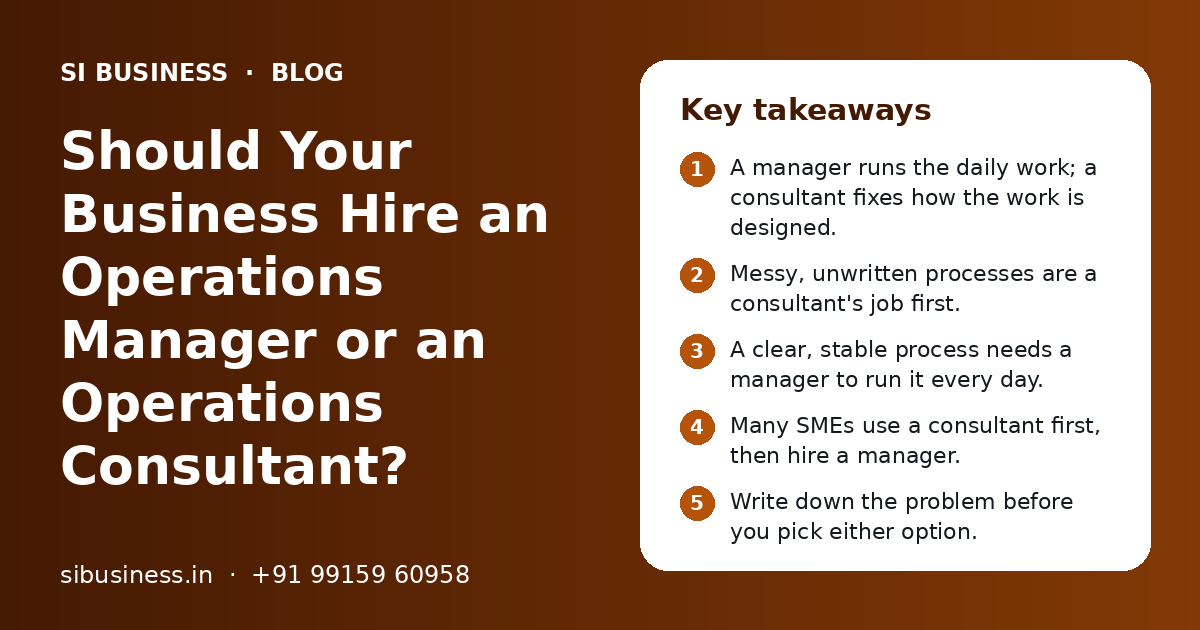
- A manager runs the daily work; a consultant fixes how the work is designed.
- Messy, unwritten processes are a consultant's job first.
- A clear, stable process needs a manager to run it every day.
- Many SMEs use a consultant first, then hire a manager.
- Write down the problem before you pick either option.
- Judge both on results you can measure, not on activity.
Operations manager vs operations consultant: what is the difference?
An operations manager is a full-time employee who runs your daily operations and makes sure work gets done. An operations consultant is an outside expert who studies how your business works, finds what is broken and helps you fix it within a fixed time.
Think of it like a delivery vehicle. The manager is the driver who takes it out every day. The consultant is the workshop that finds why the vehicle keeps breaking down and repairs it. You need both at different times. Hiring a good driver will not fix a faulty engine, and a repaired engine still needs a driver.
What does an operations manager do day to day?
An operations manager plans and checks the daily work, manages the team, handles problems as they come and reports progress to the owner. Their value is steady, daily control.
- Plans the day or week for staff, shifts and deliveries
- Checks that orders, jobs and service requests move on time
- Handles staff issues, leave and work allocation
- Solves daily problems such as a late supplier or a customer complaint
- Talks to vendors, transporters and service partners
- Shares daily or weekly numbers with the owner
- Makes sure SOPs and rules are followed
A good manager takes daily pressure off the owner. But most managers are hired to run what already exists. If the process itself is broken, a manager often spends the whole day firefighting the same problems again and again. They rarely have time to redesign the system while also running it.
What does an operations consultant do for a small business?
An operations consultant studies how work really flows, finds the delays and waste, designs a better way and helps your team put it in place. Their value is a fresh, outside view and a fixed, focused project.
- 1
Understand the problem
Talk to the owner and key staff to learn what feels slow, costly or out of control.
- 2
Map the current process
Draw how work actually moves today, step by step, including hand-offs, approvals and waiting time.
- 3
Find the root causes
Look for double entry, unclear owners, missing data, long approvals and repeated mistakes.
- 4
Design a better process
Remove steps that add no value, set clear owners and time limits, and plan simple tools where they help.
- 5
Write SOPs and set numbers
Document the new way of working and choose a few numbers to track it.
- 6
Train and hand over
Train the team, support the first weeks of change and hand the system to an internal owner.
This is close to how an operations audit and a business process optimization project work. The consultant does not stay forever. The goal is to leave behind a process your own people can run.
How do an operations manager and an operations consultant compare side by side?
The main differences are in time, focus, cost structure and who owns the result after the work is done. The table below shows them in one view.
| Factor | Operations manager | Operations consultant |
|---|---|---|
| Type of role | Full-time employee | Outside expert for a set project |
| Main focus | Running daily work | Fixing how work is designed |
| Time frame | Ongoing, long term | Fixed weeks or months |
| Cost structure | Monthly salary and benefits | Project or monthly fee for a set scope |
| Fresh view | Lower after some time inside | High, sees problems staff have stopped noticing |
| Knowledge of your business | Grows deep over time | Learns fast for the project |
| Best when | Processes are clear and need daily control | Processes are messy, unwritten or slow |
| Output | Daily results and team control | Process maps, SOPs, tools plan, dashboards |
| Risk if wrong choice | Hired to firefight a broken system | Plan made but nobody inside runs it |
When should you hire an operations manager?
Hire an operations manager when your processes are mostly clear and written down, but nobody has the time to run them every day. A manager is the right fit when the problem is daily control, not design.
- Your main processes are written as SOPs and people mostly follow them
- The owner spends too much time on routine daily decisions
- The business is steady and the work repeats in a known pattern
- You can describe the role clearly: what they own and how you will judge them
- You already track a few key numbers each week
- You need someone on the floor every day to manage staff and vendors
What to check before you hire
Write a clear role note before you post the job. List the processes they will own, the decisions they can take without you and the numbers they will report. Without this, even a strong manager will drift into doing whatever is urgent that day. A simple KPI dashboard for business owners helps you and the new manager agree on what good looks like from the first month.
When should you bring in an operations consultant?
Bring in an operations consultant when processes are messy, unwritten or keep breaking, or when you are about to make a big change. A consultant is the right fit when the problem is design, not daily control.
- Work depends on one or two people who know how everything is done
- The same problems come back every week, no matter who handles them
- Every team does the same task in a different way
- You plan to buy a CRM, ERP or other software and are not sure what you need
- You are opening a new branch, warehouse or shift
- Profit is falling even though sales are steady or growing
- You hired a manager before, and they spent all their time firefighting
A consultant also helps when you need skills you do not have inside, such as process mapping, workflow design or setting up dashboards. If your plan includes new systems, our page on technology strategy for business explains how to plan software around your process instead of the other way round.
What affects the cost of each option?
The cost of a manager depends on experience, city and role size. The cost of a consultant depends on the scope of the project, the number of processes and locations, and how long support is needed. Compare the full cost, not just the monthly number.
| Cost factor | Operations manager | Operations consultant |
|---|---|---|
| Main driver | Experience level and local salary market | Number of processes, teams and branches in scope |
| Hidden costs | Hiring time, notice period, training, benefits | Your team's time for interviews and workshops |
| Time to useful results | Weeks to learn your business | Starts with study, then fixes in planned stages |
| Cost of a bad fit | Months of salary and lost time | A project that ends with a plan nobody runs |
| Commitment | Ongoing | Ends when the scope is done |
We do not publish fixed prices, because every business is different. With SI Business, you get a clear quote after a free call, based on the processes, teams and locations you want to improve. Ask any provider to put the scope, the outputs and the timeline in writing before you agree.
Can you use both a consultant and a manager together?
Yes, and for many growing SMEs this works best. A consultant fixes and documents the processes first, then an operations manager runs the improved system every day.
- The consultant maps your current processes and finds the main delays.
- Together, you agree on the new way of working and the key numbers.
- The consultant writes SOPs and sets up simple tools and dashboards.
- You hire or promote an operations manager to own the new system.
- The consultant trains the manager and supports the first weeks.
- The manager runs daily work and reviews the numbers with you each week.
This order matters. When the manager joins after the process is fixed, they start with clear SOPs, clear numbers and a clear role. They can spend their time running the business instead of discovering how it works. Clear SOP documentation makes this hand-over much smoother.
What mistakes do owners make when choosing operations help?
The most common mistakes are hiring a manager to fix a broken system, hiring a consultant without a clear goal, and not naming an internal owner. Each one wastes time and money.
Good habits
- Write down the problem in one page before choosing
- Agree on three to five numbers that show success
- Name one internal owner for every change
- Ask for written scope, outputs and timeline
- Review progress every week or every two weeks
Common mistakes
- Hiring a manager and expecting them to redesign everything alone
- Hiring a consultant for a vague goal like "improve operations"
- Buying software before fixing the process
- Keeping every decision with the owner after hiring help
- Judging help by hours spent instead of results
How can SI Business help you decide and improve operations?
We start with a free call to understand your problem. If your processes need fixing, we work as your operations consultant. If they are already clear, we help you set up the numbers and role note so a manager can run them well.
Operations review
We study how work really flows and show where time and money are lost.
Process redesign
We remove delays and set clear owners, time limits and SOPs.
Dashboards and tools
We set up simple numbers and tools your team will use.
Hand-over to your team
We train your manager or senior staff to run the new system.
SI Business is powered by Shivah Web Tech, with 11+ years of work, a 25+ in-house team and 500+ projects, from our office in Mohali, Punjab. We work with businesses across India and abroad, including family firms moving to modern systems through family business digitization. Book a free call and we will tell you honestly which option fits your business today.
Related Pages
Operations Audit
A clear check of where time, money and customers are being lost.
Process Optimization
Map, simplify and speed up the way key work gets done.
SOP Documentation
Clear, short SOPs so every task is done the same right way.
Owner KPI Dashboard
One screen with the few numbers that tell you how the business is doing.
Frequently Asked Questions
Is an operations consultant worth it for a small business?
It can be, if you have a clear problem such as slow orders, repeated mistakes or work that depends on one person. A consultant gives you a fresh view and a fixed project with clear outputs. It is less useful if the goal is vague or nobody inside will own the changes. Write down the problem first, then decide.
When should a small business hire its first operations manager?
Hire your first operations manager when the owner spends most of the day on routine decisions and the main processes are clear enough to hand over. If processes are still unwritten or keep breaking, fix them first. Otherwise the new manager will spend all their time firefighting, and you may wrongly think the hire failed.
Can an operations consultant replace an operations manager?
Not usually. A consultant works on a fixed project to fix how work is designed. Daily work still needs someone inside to run it, check it and handle problems. Some consultants offer ongoing monthly support, but this works best as a review and guidance role, with an internal person owning the daily work.
How long does an operations consulting project take?
It depends on the number of processes, teams and branches in scope. A focused project on one or two processes is shorter than a full review of the whole business. Most projects have stages: study, redesign, SOPs and training, then a support period. Ask for a written timeline with clear outputs at each stage.
Which is cheaper, an operations manager or an operations consultant?
There is no single answer. A manager is an ongoing salary cost with hiring and training time. A consultant is a project cost that ends when the scope is done. Compare the full cost over a year, and the cost of a wrong choice. You get a clear quote from SI Business after a free call.
What should I ask an operations consultant before hiring them?
Ask how they will study your current process, what you will receive at the end, how long each stage takes and who from your team needs to be involved. Ask how they hand over the work so your team can run it. Ask how success will be measured, and get the scope and outputs in writing.
Can I promote an existing employee to operations manager?
Yes, and it often works well because they already know your business, customers and staff. Give them a clear role note, written SOPs, a few key numbers and some training. Support them for the first months and give them real authority to decide. Without that authority, they will still send every decision back to you.
Do family businesses need an operations consultant or a manager?
Many family businesses run on trust and memory, with key knowledge held by family members. A consultant can help write down processes and set clear roles, which makes it easier to bring in a manager from outside later. The right order is often to document first, then hire, so the new person is not lost.
Talk to our team today
Call or WhatsApp +91 99159 60958. We reply fast, Monday to Friday.